2026 Gettysburg Quarter Errors: What to Look For
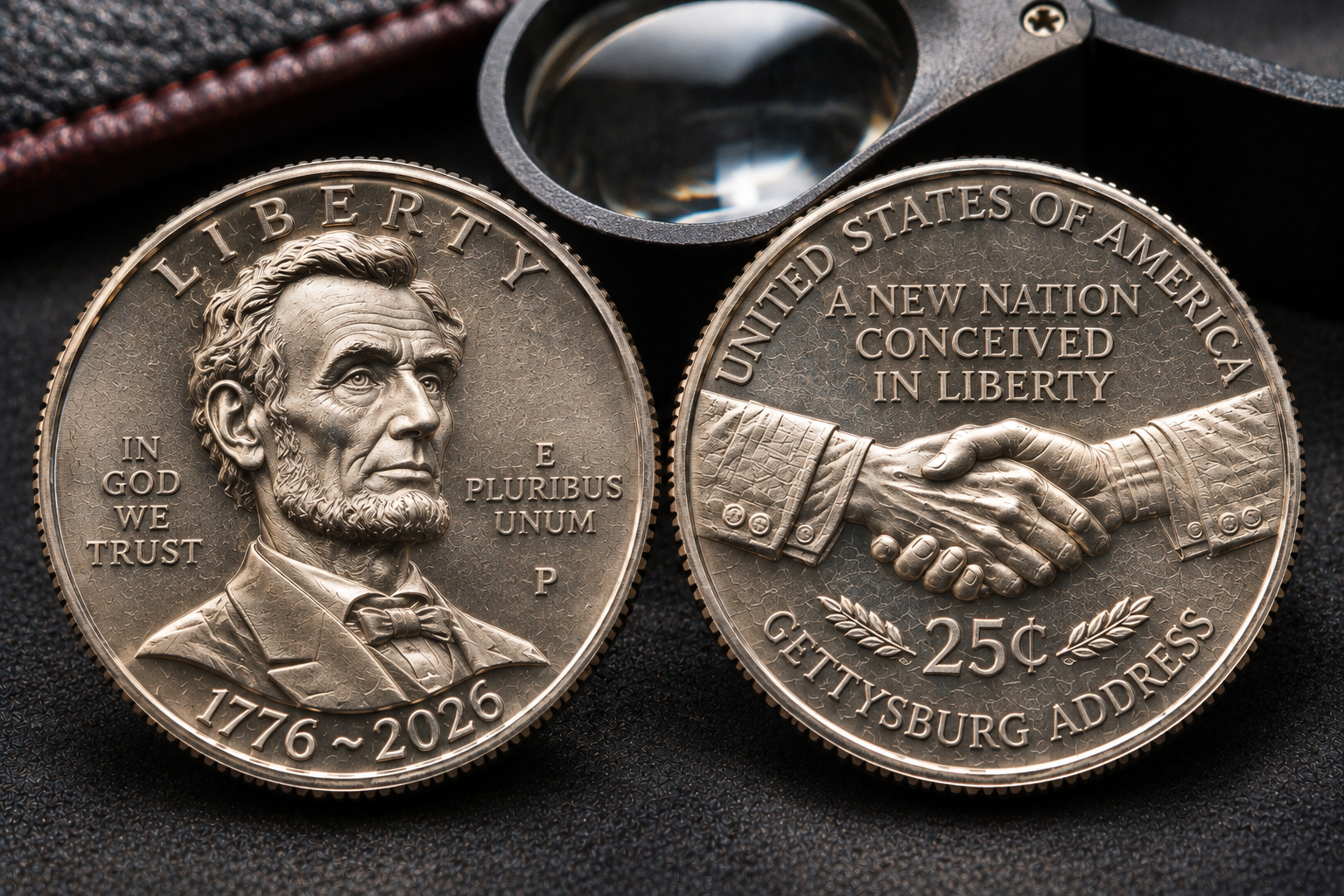
Look closely at the two clasped hands on a 2026 Gettysburg Address quarter. Between the fingers, around the knuckles, and along the wrists, small sculptural details can create the appearance of extra lines, unusual metal formations, or even doubled features.
Turn the coin over, and Abraham Lincoln’s deeply detailed portrait presents another challenge. His facial wrinkles, beard, and surrounding inscriptions contain features that an inexperienced collector could easily mistake for mint errors.
The difficulty with examining a newly introduced coin is that collectors are still becoming familiar with its normal appearance. The 2026 Gettysburg Address quarter is no exception.
Released into circulation on October 19, 2026, this quarter concludes America’s five-design Semiquincentennial quarter series. Its distinctive artwork provides several interesting areas for examination, but unusual features must be evaluated against genuine manufacturing diagnostics before they can be classified as errors.
What This Article Explains
- How to examine Lincoln’s portrait for genuine die-related anomalies.
- Why unusual details between the clasped hands may be misleading.
- How to distinguish die cracks, die chips, and possible die clashes.
- How to recognize machine doubling rather than assuming a doubled die.
- Which physical measurements matter when investigating a suspected error.
- What is currently documented about 2026 Gettysburg quarter errors.
- When a suspicious quarter may justify professional authentication.
Table of Contents
- What Counts as a Real Gettysburg Quarter Error?
- Start With the Official Gettysburg Address Design
- Why Lincoln’s Portrait Can Be Misleading
- Is That Extra Metal Between the Hands a Mint Error?
- Die Cracks and Die Chips
- Doubled Die, Machine Doubling, or Die Deterioration?
- How to Investigate a Possible Die Clash
- Off-Center Strikes, Broadstrikes, and Unusual Rims
- Missing Letters and Struck-Through Errors
- Missing Clad Layer vs. Copper-Colored Damage
- Are Any 2026 Gettysburg Quarter Errors Confirmed?
- How to Examine Your Quarter in Five Minutes
- How Much Is a 2026 Gettysburg Quarter Error Worth?
- Frequently Asked Questions
What Counts as a Real Gettysburg Quarter Error?
Not every unusual coin is an error coin. Accurate identification begins by determining when and how an unexpected feature was created.
A mint error may originate in the preparation of the metal blank or during the striking process. A die variety originates in the die, while die-state features develop as a working die changes or deteriorates.
Damage sustained after striking belongs to a separate category, even when it occurs before the coin enters everyday circulation.
| Category | Origin | Example |
|---|---|---|
| Mint error | Planchet preparation or striking process | Off-center strike |
| Die variety | Variation originating in the die | Doubled die |
| Die-state feature | Changes to a working die | Die crack or die chip |
| Post-mint damage | Alteration after striking | Scratch or impact mark |
| Normal design | Intentional sculptural detail | Lincoln’s facial wrinkles |
These distinctions are especially important for newly designed coins. The same principles apply to other anniversary issues, as explained in our guide to 2026 Emerging Liberty dime errors and how collectors distinguish minting anomalies from ordinary damage.
Start With the Official Gettysburg Address Design
Before examining an unusual line or raised feature, establish what the coin is supposed to look like.
The obverse features Abraham Lincoln with detailed facial modeling. It carries the inscriptions E PLURIBUS UNUM, IN GOD WE TRUST, and the anniversary date 1776 ~ 2026.
The reverse depicts two hands clasped together. Its inscriptions include UNITED STATES OF AMERICA, A NEW NATION CONCEIVED IN LIBERTY, 25¢, and GETTYSBURG ADDRESS.
Circulation strikes carry Philadelphia’s P or Denver’s D mint mark. Neither version has an anniversary privy mark.
The absence of a privy mark is therefore normal and should never be advertised as a missing-symbol error.
Official Physical Specifications
| Specification | Standard Circulating Quarter |
|---|---|
| Face value | 25 cents |
| Weight | 5.670 grams |
| Diameter | 24.26 mm |
| Composition | 91.67% copper, 8.33% nickel |
| Edge | Reeded |
| Mint marks | P and D |
| Privy mark | None |
| Circulation release | October 19, 2026 |
These specifications apply to the standard copper-nickel clad circulation issue. Collector versions made with different materials or finishes require their own reference specifications.
Why Lincoln’s Portrait Can Be Misleading
Lincoln’s portrait is intentionally detailed. The design communicates the physical and emotional burden of the Civil War through his weathered appearance.
Wrinkles, hair strands, beard contours, and transitions between raised and recessed areas are part of the sculpture.
Under strong directional lighting, a shallow wrinkle can appear more pronounced. Under magnification, adjacent contours may resemble doubled lines.
Start by examining these areas:
- The forehead and wrinkles surrounding the eyes.
- The transition between the nose and cheeks.
- The beard and surrounding hair details.
- The boundary between the portrait and the surrounding field.
- The anniversary date and nearby inscriptions.
Rotate the coin slowly under a fixed light source. If the apparent anomaly changes dramatically or disappears as the lighting angle changes, reflections from the sculptural relief may be contributing to its appearance.
A genuine physical feature remains present even when its visibility changes.
Comparing another Gettysburg quarter under identical lighting is often more informative than increasing magnification.
Is That Extra Metal Between the Hands a Mint Error?
The clasped-hands reverse is arguably the most interesting part of this quarter to examine because the design contains overlapping forms and numerous closely spaced contours.
Areas around the fingers, knuckles, wrists, and sleeves can create visual ambiguity. A collector may see what appears to be an additional finger or a small raised piece of metal.
There are several possible explanations.
Normal Sculptural Detail
An overlapping finger, skin fold, or transition between the hands may appear unusual when viewed in isolation.
Always compare the feature with official design images and another normal coin before assuming that additional metal is present.
A Possible Die Chip
If a small fragment breaks away from a working die, the resulting cavity can fill with metal during striking. This produces a raised feature that was not intended as part of the original design.
A genuine die chip near a finger could alter its apparent outline. Nevertheless, the feature must be examined before it can be attributed to a chipped die.
Displaced Metal From an Impact
A contact mark can push metal upward beside an indentation, creating the appearance of an extra raised detail.
Look for a nearby depression, compressed design elements, or an interruption in the original surface texture.
Apparent Doubling
Secondary contours along a finger may result from machine doubling, a die-related feature, or the normal sculpture itself.
Describing an unusual finger as a doubled-die variety requires substantially more evidence than simply counting visible outlines.
Die Cracks and Die Chips on the Gettysburg Quarter
Repeated striking places considerable stress on coin dies. Cracks may develop, and small sections of a die can occasionally break away.
When metal enters these openings during striking, it creates raised features on the finished coin.
Recognizing a Die Crack
A die crack generally appears as an irregular raised line. It may cross a relatively flat field or continue through portions of the design.
On the Gettysburg quarter, suspicious lines should be examined where they intersect Lincoln’s portrait, lettering, or the reverse’s detailed relief.
A line that follows an existing wrinkle or finger contour could simply belong to the original artwork.
Conversely, an irregular line crossing otherwise unrelated design elements may justify closer examination.
Recognizing a Die Chip
A die chip typically produces a raised area of unintended metal. Small chips may be relatively inconsequential, while larger or more distinctive examples can attract greater collector interest.
Check whether a suspected chip has adjacent impact damage. An isolated raised feature without an obvious corresponding indentation may warrant further investigation, although this characteristic is not conclusive by itself.
The most useful question is not whether a mark looks unusual. It is whether the surrounding metal behaves as expected for the proposed minting anomaly.
Doubled Die, Machine Doubling, or Die Deterioration?
Apparent doubling is one of the most frequently misunderstood features on modern American coins.
The Gettysburg quarter offers several areas where collectors may notice secondary contours, including the anniversary date, lettering, and outlines of the hands.
However, different manufacturing mechanisms can produce superficially similar appearances.
| Feature | Typical Characteristics |
|---|---|
| True doubled die | Duplicated or distorted design features originating in the die and reproducible on coins struck from it. |
| Machine doubling | Often presents flattened, shelf-like secondary edges associated with movement during striking. |
| Die deterioration doubling | Distorted or expanded-looking details associated with changes to a worn working die. |
| Normal sculptural relief | Intentional overlapping contours and transitions within the original artwork. |
| Post-mint damage | Compressed, displaced, or distorted metal caused by later contact. |
Traditional doubled-die diagnostics can include separation or notching in affected design elements. Modern doubled dies, however, do not always display the dramatic separation familiar from famous historical varieties.
For that reason, the absence of obvious notching does not automatically rule out a genuine doubled die.
A credible attribution should identify the affected design elements precisely and compare them with reliable documented examples when available.
Until that evidence exists, a suspicious Gettysburg quarter is better described as having apparent doubling rather than being advertised as a confirmed doubled die.
How to Investigate a Possible Die Clash
Die clashes occur when the obverse and reverse dies contact each other without a planchet properly separating them.
This contact can leave unintended impressions on the dies. Coins struck afterward may reproduce portions of those impressions as faint, unexpected design traces.
One useful investigative technique involves a die-clash overlay.
An overlay superimposes appropriately oriented images of the obverse and reverse so a collector can investigate where transferred design features might appear.
NumisDex includes a predictive die-clash overlay for the 2026-D Gettysburg Address quarter in its reference collection.
The overlay can help evaluate whether an unusual mark is consistent with the opposing design’s geometry.
However, coincidence in location is insufficient. The feature’s shape, orientation, surface characteristics, and relationship to nearby relief must also support the proposed explanation.
Off-Center Strikes, Broadstrikes, and Unusual Rims
Unlike subtle die varieties, major striking anomalies can change the appearance of an entire coin.
Off-Center Strikes
An off-center strike occurs when a planchet is incorrectly positioned relative to the dies. Part of the design is displaced, leaving a portion of the planchet unstruck.
On a suspected Gettysburg quarter, examine both sides for corresponding design displacement and an identifiable unstruck area.
An uneven rim alone may indicate a minor alignment issue rather than a genuine off-center strike.
Broadstrikes
A broadstrike occurs when the normal restraining action of the collar is absent during striking, allowing the metal to spread outward.
The coin may have an expanded diameter, altered edge characteristics, and an unusual outline.
Compare the suspected coin with the standard diameter of 24.26 mm, but remember that external pressure can also deform a quarter.
Partial Collar Errors
If a planchet is only partly contained by the collar during striking, its edge may develop an unusual stepped profile.
A genuine partial collar error should be evaluated through the relationship between edge reeding, metal expansion, and the affected portion of the coin.
Damage from machinery or repeated impacts can create misleading edge characteristics. Measuring diameter without examining the entire edge is insufficient.
Missing Letters and Struck-Through Errors
The Gettysburg quarter contains several inscriptions, providing useful reference areas when investigating incomplete details.
Foreign material between a die and planchet can interfere with the transfer of the design. Depending on the material and circumstances, it may produce missing, weakened, or depressed features.
Grease-related striking anomalies can sometimes result in weak or incomplete lettering.
But circulation wear, die deterioration, weak striking pressure, and surface damage can also reduce detail.
Examine the missing feature in relation to adjacent letters and the surrounding surface. A localized interruption on an otherwise well-preserved coin may deserve closer attention.
There is no reliable basis for describing every Gettysburg quarter with a weak letter as a rare error.
Missing Clad Layer vs. Copper-Colored Damage
Standard circulating quarters consist of a copper core bonded to outer copper-nickel layers.
If one of those outer layers is absent before striking, the resulting coin may display an exposed copper-colored surface and a substantial reduction in weight.
A copper-colored Gettysburg quarter is therefore worth examining, but color alone cannot establish a missing-clad-layer error.
Environmental exposure, chemical reactions, plating, and deliberate alteration can produce similar appearances.
Use a calibrated scale capable of measuring hundredths of a gram. Compare the result with the nominal weight of 5.670 grams, examine the edge, and study the affected surface under magnification.
Normal manufacturing tolerances, circulation wear, and measurement accuracy must be considered before interpreting the result.
A visible copper stripe along the edge of an otherwise normal clad quarter is expected and does not represent a missing-clad-layer error.
Are Any 2026 Gettysburg Quarter Errors Confirmed?
The Gettysburg Address quarter entered circulation relatively late in the anniversary year, and collectors are still examining newly distributed examples.
As of November 25, 2026, the sources reviewed for this article do not provide sufficient attribution evidence to identify a specific major doubled-die or clasped-hands variety as an established discovery.
The available predictive die-clash overlay provides a useful examination reference, but it does not document an authenticated error specimen.
This does not establish that genuine errors are absent from the issue. Individual mint errors can exist without appearing immediately in published references.
Future discoveries should be evaluated through clear photographs, precise diagnostics, independent examination, and recognized attribution references where applicable.
How to Examine Your Gettysburg Quarter in Five Minutes
Many suspicious coins can be evaluated initially without expensive equipment.
Begin with a normal comparison coin, a 5x or 10x loupe, and a movable light source.
- First minute: Confirm the Gettysburg design, anniversary date, and P or D mint mark.
- Second minute: Examine Lincoln’s portrait, particularly the facial contours and nearby inscriptions.
- Third minute: Inspect the hands, looking for interruptions in the normal finger and knuckle contours.
- Fourth minute: Examine the rim and edge for deformation, abnormal reeding, or evidence of impact.
- Fifth minute: Compare suspicious features under different lighting angles and record any measurable differences.
If the coin still appears unusual, photograph both sides and the relevant detail. Record its mint mark, weight, and diameter before seeking further evaluation.
Do not clean or scrape the suspected area. Original surfaces may preserve valuable diagnostic evidence.
2026 Gettysburg Quarter Error Diagnostic Chart
| What You Notice | Possible Explanation | What to Check |
|---|---|---|
| Extra metal between fingers | Die chip, normal relief, or displaced metal | Original design and nearby depressions |
| Raised line across Lincoln’s face | Die crack or normal contour | Relief, continuity, and comparison coins |
| Doubled anniversary date | Doubled die or machine doubling | Shape and repeatability of features |
| Weak or missing lettering | Struck-through material, weak strike, or wear | Surrounding details and surface texture |
| Copper-colored surface | Missing clad layer or environmental damage | Weight, edge, and surface characteristics |
| Unexpected design traces | Possible die clash | Opposing design geometry |
| Uneven rim | Die alignment issue, strike anomaly, or damage | Both faces and the complete edge |
| Expanded diameter | Broadstrike or external deformation | Metal flow and edge characteristics |
| Missing privy mark | Normal circulation design | Official Mint specifications |
How Much Is a 2026 Gettysburg Quarter Error Worth?
There is no universal price for a Gettysburg Address quarter with an unusual feature.
Even authenticated mint errors can differ considerably in collector appeal depending on their type, severity, condition, and scarcity.
For example, a dramatic off-center strike with an identifiable date and mint mark may attract a different level of demand than a minor die chip.
Other important considerations include:
- Whether the anomaly has been independently authenticated.
- How clearly the error can be recognized.
- Whether the coin retains attractive original surfaces.
- How many comparable examples are documented.
- Recent completed sales of similar authenticated coins.
The temporary anniversary design may generate additional collector interest, but it does not automatically give every unusual specimen a substantial premium.
A seller’s asking price is not proof of market value. Likewise, the limited availability of packaged Mint products does not establish the rarity of a particular mint error.
Professional authentication may be appropriate for convincing or significant anomalies. For minor features, submission fees could exceed any achievable collector premium.
Final Verdict: Learn the Design Before Searching for Errors
The 2026 Gettysburg Address quarter rewards careful examination because its portrait and clasped-hands reverse contain complex sculptural details.
Those details can help collectors recognize genuine abnormalities, but they can also create misleading impressions of doubling, extra metal, or missing features.
The strongest approach is to begin with official design references, compare multiple examples, examine the original surfaces, and investigate suspicious features through established minting diagnostics.
For now, collectors should treat claims of an Extra Finger Error, major doubled die, or distinctive clash variety as unverified unless accompanied by credible attribution evidence.
A genuine discovery begins with understanding what should be present on the coin before identifying something that should not be there.
Frequently Asked Questions
What errors should collectors look for on a 2026 Gettysburg Address quarter?
Collectors can investigate possible die cracks, die chips, doubled dies, die clashes, off-center strikes, broadstrikes, struck-through anomalies, and missing clad layers. These are recognized general error categories rather than a confirmed list of Gettysburg quarter errors.
Are any 2026 Gettysburg quarter errors confirmed?
As of November 25, 2026, the sources reviewed for this guide do not establish a specific major doubled-die or clasped-hands variety. Individual discoveries require supporting evidence and authentication.
Does the 2026 Gettysburg quarter have an Extra Finger Error?
No authenticated variety under that name was established by the references reviewed for this article. Apparent additional finger details may result from normal sculptural relief, die-related anomalies, or displaced metal.
Is extra metal between the hands a mint error?
Possibly, but it is not conclusive. A raised feature could result from a die chip, ordinary sculptural detail, or metal displaced by an impact. Comparison and magnified examination are necessary.
What causes raised lines on Lincoln’s face?
Some raised lines may originate from die cracks, while others belong to the intended portrait or represent different die-related features. Examine whether the line corresponds with official design details.
How can I identify a doubled-die Gettysburg quarter?
Look for duplicated or distorted design elements consistent with a genuine die variety. Compare the affected areas with documented diagnostics and distinguish them from machine doubling and die deterioration.
Is a copper-colored Gettysburg quarter a missing-clad-layer error?
Not automatically. Chemical alteration, environmental exposure, and plating can produce similar coloration. Surface examination, edge characteristics, and accurate weight measurements are essential.
Can both Philadelphia and Denver Gettysburg quarters have mint errors?
Yes. Manufacturing anomalies can occur at either facility. However, a P or D mint mark by itself does not establish rarity or confirm the presence of an error.
Is the missing privy mark on my Gettysburg quarter an error?
No. The standard circulating Gettysburg Address quarter was intentionally produced without a privy mark.
How much is a 2026 Gettysburg quarter with an error worth?
Its potential value depends on the authenticated error type, severity, condition, scarcity, and completed sales of comparable specimens. An unusual appearance alone does not establish a market premium.
Should I have my Gettysburg quarter professionally authenticated?
Professional authentication may be worthwhile when the suspected anomaly is significant and supported by convincing manufacturing evidence. Consider the likely collector demand and submission costs first.
Sources and Further Reading
- United States Mint: Gettysburg Address Quarter Official Design and Physical Specifications
- United States Mint: Release of the Gettysburg Address Quarter, October 21, 2026
- United States Mint: 2026 Circulating Coins Identification Chart
- Error-Ref: Technical Reference for Minting Errors and Die Anomalies
- Professional Coin Grading Service: Coin Authentication and Numismatic Resources
- NumisDex: Predictive Die Clash Overlays, Including the 2026-D Gettysburg Address Quarter