2026 American Innovation Reverse Proof Set: What to Look for Before October 13
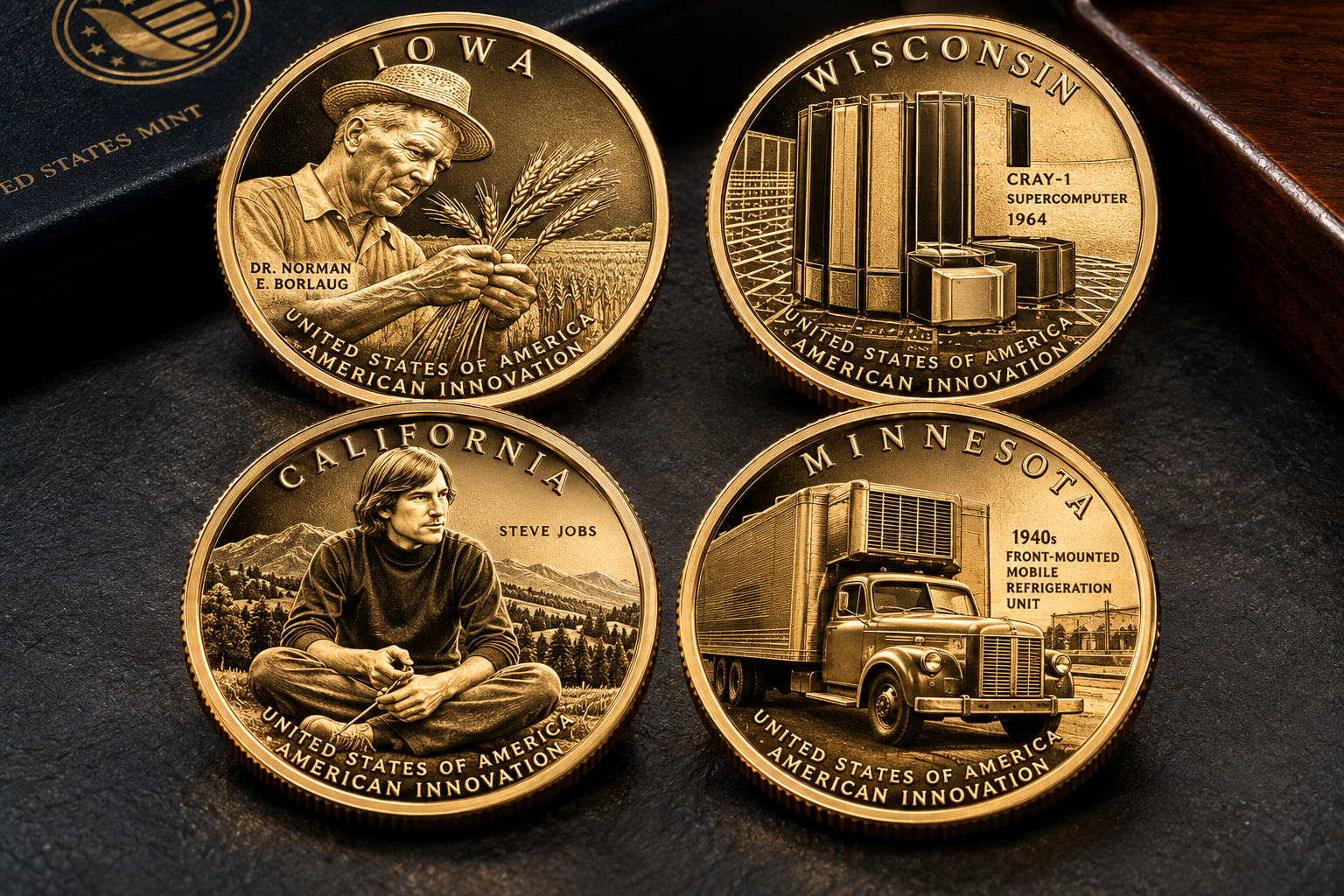
Four coins make up the 2026 American Innovation $1 Coin Reverse Proof Set, but they tell four remarkably different stories. One focuses on wheat and agricultural science. Another celebrates an early supercomputer. A third features Steve Jobs. The fourth looks back at a technology that transformed refrigerated transportation.
The United States Mint currently schedules the set for release on October 13, 2026, at noon Eastern Time. The four $1 coins honor innovations and innovators associated with Iowa, Wisconsin, California, and Minnesota, and each is produced at the San Francisco Mint with a Reverse Proof finish.
For collectors, however, the subjects are only part of the story. The unusual finish, the 2026 anniversary privy mark, the lettered edges, and the very different visual structures of the four reverse designs make this set especially useful for careful side-by-side examination.
What This Article Explains
- Which four coins are included in the 2026 American Innovation Reverse Proof Set.
- What Reverse Proof actually means when examining the surfaces.
- Where to look for the special 2026 Liberty Bell and 250 privy mark.
- What makes the Iowa, Wisconsin, California, and Minnesota designs different.
- Why the edge is an important part of every coin in the set.
- How to compare four Reverse Proof coins under the same lighting.
- Why an unusual reflection should not automatically be called an error.
Table of Contents
- What Is in the 2026 Reverse Proof Set?
- First Understand What Reverse Proof Means
- Before the Reverses, Look at the Obverse
- Iowa: Norman Borlaug and the Wheat
- Wisconsin: The Cray-1 Supercomputer
- California: The Steve Jobs Dollar
- Minnesota: Mobile Refrigeration
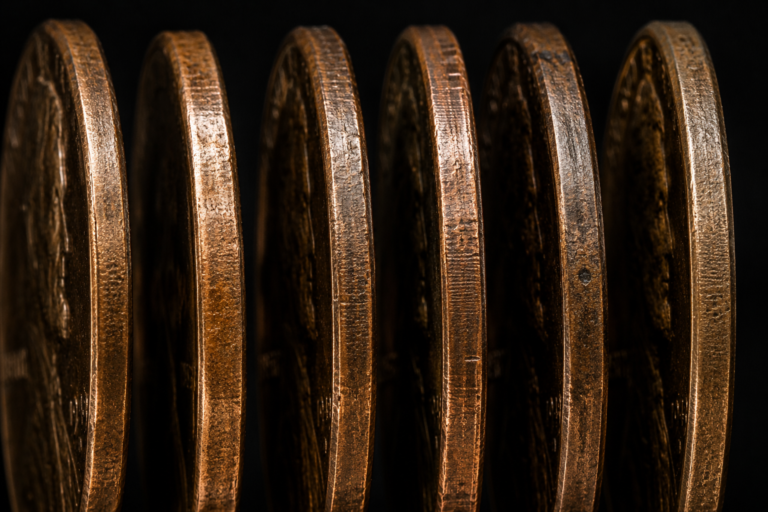
- The Edge Is Part of the Coin
- Compare All Four Reverse Proof Surfaces
- Do Not Confuse a Surface Feature With an Error
- The 2026 Privy Mark Deserves Its Own Inspection
- The Collector’s 45-Second Examination
What Is in the 2026 Reverse Proof Set?
The 2026 set contains four American Innovation $1 coins representing Iowa, Wisconsin, California, and Minnesota.
Iowa honors Dr. Norman Borlaug and his agricultural work. Wisconsin celebrates the Cray-1 supercomputer. California features Steve Jobs. Minnesota recognizes mobile refrigeration and its effect on transporting temperature-sensitive products.
All four coins have a denomination of $1 and are struck at the San Francisco Mint. Each weighs 8.100 grams and measures 26.49 millimeters in diameter. Their composition is primarily copper, with 6 percent zinc, 3.5 percent manganese, and 2 percent nickel.
The U.S. Mint currently lists the set at $60 and gives the four coins a mintage limit of 99,792. The current product page does not list a separate product limit and shows a household order limit of two. Because the set has not yet reached its scheduled October 13 release, these should be treated as current pre-release product details rather than final sales figures.
| Coin | Main Subject | Best Detail to Examine | Reverse Proof Character |
|---|---|---|---|
| Iowa | Norman Borlaug | Portrait and wheat | Organic fine detail |
| Wisconsin | Cray-1 Supercomputer | Circular geometry | Strong geometric contrast |
| California | Steve Jobs | Figure and landscape | Broad, visually quiet areas |
| Minnesota | Mobile refrigeration | Truck and mechanical details | Numerous small design elements |
First Understand What Reverse Proof Means
The words Reverse Proof are important because these coins are not intended to look exactly like conventional proof coins.
A traditional proof appearance commonly emphasizes mirror-like fields against frosted devices. On these American Innovation Reverse Proof dollars, the visual relationship is reversed: the raised foreground design elements have a brilliant, reflective appearance against a frosted background.
That difference changes how your eye reads the coin.
Instead of allowing the broad field to provide the strongest reflection, watch how individual design elements react as the coin moves under light. Portraits, lettering, wheat, machinery, and other raised features can flash against the quieter frosted background.
This is why you should use directional light to understand the Reverse Proof surfaces rather than judging them from one bright overhead reflection.
Reverse Proof describes the finish. It does not mean the coin is a different denomination, and it does not guarantee that every individual example will be visually flawless.
Before the Reverses, Look at the Obverse
It is easy to begin with the four state designs because they are what distinguish the coins from one another. But the shared obverse contains one of the most interesting details of the 2026 issues.
All four coins use the American Innovation program’s Statue of Liberty obverse.
For the nation’s 250th anniversary year, the program’s gear-shaped privy mark incorporates a Liberty Bell and the number 250. That small modification connects the 2026 American Innovation dollars to the broader Semiquincentennial year without replacing the program’s established Statue of Liberty obverse.
Make the privy mark one of the first details you locate.
Then compare it across all four coins. Because the basic obverse and finish are shared, the four-piece set gives collectors an unusually convenient opportunity to compare the same small design feature on multiple coins under identical lighting.
Iowa: Norman Borlaug and the Wheat
The Iowa reverse honors Dr. Norman Borlaug, whose agricultural research became closely associated with the Green Revolution.
The design shows Borlaug holding a sheaf of wheat, surrounded by wheat stalks. The inscriptions identify him as NORMAN BORLAUG and FATHER OF THE GREEN REVOLUTION.
For examination purposes, this coin gives you a mixture of portrait detail, organic shapes, fine wheat elements, and lettering.
Begin with the portrait, then move outward toward the wheat. Watch how the reflective raised elements respond to the light against the frosted background.
Fine lines within the wheat are especially useful for evaluating definition. Do not confuse intended design lines with scratches simply because they become bright under directional light.
Wisconsin: The Cray-1 Supercomputer
The Wisconsin coin provides a completely different visual experience.
Its reverse uses a stylized aerial representation of the Cray-1 supercomputer, the influential machine developed under computer architect Seymour Cray. The design’s shape also evokes the letter C, connecting visually with both Cray and computer.
Unlike the Iowa design, there is no human portrait dominating the composition. Geometry becomes the main feature.
Follow the curved structure around the reverse. Look at the boundaries between reflective devices and frosted background, and notice how the symmetrical elements react as you rotate the coin.
This makes Wisconsin particularly useful for studying how Reverse Proof works on geometric forms. A portrait produces irregular highlights. A structured technological design can produce a much more organized sequence of reflections.
California: The Steve Jobs Dollar
The California American Innovation dollar is likely to be immediately recognizable because its subject is Steve Jobs.
The reverse depicts a young Jobs seated in front of a Northern California landscape of rolling hills. The design includes the inscription MAKE SOMETHING WONDERFUL.
But from a collector’s perspective, the interesting feature is not simply the famous name.
The design combines a relatively small human figure with broad landscape elements and visually quieter areas. That makes it fundamentally different from the wheat-filled Iowa design or the geometric Wisconsin reverse.
Study the separation between Jobs and the landscape. Then examine the open portions of the composition as you change the angle of light.
Quiet areas deserve attention because small surface disturbances can become easier to notice where there is less visual competition.
Do not let the popularity of the subject change the way you examine the coin. Read the design first, then evaluate the surface.
Minnesota: Mobile Refrigeration
The Minnesota dollar celebrates an innovation that is less famous by name but enormously important to modern transportation and food distribution.
The reverse depicts a 1940s-era truck fitted with an early front-mounted refrigeration unit. Additional imagery represents temperature-sensitive products that could be transported over greater distances with mobile refrigeration.
This is arguably the busiest mechanical design of the four.
Look closely at the truck, refrigeration equipment, wheels, small icons, and lettering. Fine mechanical details provide a useful place to examine the sharpness of the strike and the separation of individual elements.
Then reduce the magnification and look at the entire reverse again.
This final step matters. A coin can look impressive under magnification while appearing visually crowded at normal viewing distance, or tiny imperfections can look dramatic under magnification while becoming insignificant when you return to the whole coin.
The Edge Is Part of the Coin
Do not finish examining these dollars after looking at the obverse and reverse.
The edge contains incused inscriptions, including 2026, the S mint mark, and E PLURIBUS UNUM.
That means a collector who ignores the edge has not completely read the coin.
American Innovation dollars are an excellent example of why the edge is an essential part of coin examination. Information that would normally be expected on one of the two major faces can instead appear around the edge.
Examine the lettering carefully, but remember that orientation can vary depending on how edge lettering is applied. Do not assume that lettering appearing upside down relative to one face automatically represents an error.
Compare All Four Reverse Proof Surfaces
Once you have examined the coins individually, place them mentally or physically into a side-by-side comparison.
This is where the set becomes especially educational.
Iowa gives you a portrait and fine organic detail. Wisconsin provides strong geometry. California combines a human figure with a relatively quiet landscape. Minnesota contains numerous mechanical details.
Four very different designs share the same denomination, year, mint, and Reverse Proof concept.
That makes it easier to see how design itself affects your perception of a coin’s surface.
Use the same light source and approximately the same viewing angle for each piece. Then compare how quickly your eye notices marks, frost differences, reflective devices, and small details.
This controlled approach is one reason collectors compare coins side by side under similar conditions.
Do Not Confuse a Surface Feature With an Error
Reverse Proof coins can produce dramatic reflections, especially in photographs. A reflective device can appear extremely bright at one angle and almost dark at another.
That makes careful interpretation essential.
A tiny spot is not automatically a Mint error. A small mark is not automatically an error. A difference in frost or reflectivity is not automatically an error either.
Even packaging can influence what you think you are seeing.
If something looks unusual, rotate the coin or the entire unopened lens under a stable light source and observe whether the feature changes with the reflection. This is why experienced collectors change the viewing angle before judging reflective surfaces.
Photographs deserve the same caution. A single product image records one lighting arrangement at one moment. It cannot show every way a reflective coin behaves, which is why one photograph should not be treated as a complete surface examination.
The 2026 Privy Mark Deserves Its Own Inspection
After examining all four reverses, return to the common obverse and look again at the 2026 anniversary privy mark.
This time, compare rather than simply identify it.
You have four coins with the same basic obverse, the same Reverse Proof format, the same year, and the same mint. That provides a useful controlled comparison.
Look at the Liberty Bell and 250 detail on each coin under the same lighting. Compare sharpness and appearance without immediately assigning meaning to tiny differences.
If one looks different, change the angle first. A reflective feature may appear different simply because of light.
This is a better collecting habit than beginning with the assumption that every difference represents a variety or error.
The Collector’s 45-Second Examination
Start by confirming the four states: Iowa, Wisconsin, California, and Minnesota.
Identify the subject of each reverse. Find Borlaug and the wheat, the Cray-1 geometry, Steve Jobs and the California landscape, and the refrigerated Minnesota truck.
Turn to the common Statue of Liberty obverse and locate the special 2026 Liberty Bell and 250 privy mark.
Now use directional light. Watch the reflective design elements move against the frosted backgrounds. Compare the four coins using approximately the same angle rather than changing your setup for every piece.
Return to the small details. Examine the Iowa wheat, Wisconsin geometry, California landscape, and Minnesota machinery.
Then check the edge. Find 2026, S, and E PLURIBUS UNUM.
Finally, return to the complete set and compare the four coins as a group. Which design makes the Reverse Proof contrast easiest to read? Which contains the most visually complex details? Which gives you the clearest view of broad surface areas?
The purpose is not to choose a winner. It is to understand how four different designs behave when produced with the same unusual finish.
Reality Check
A limited U.S. Mint product is not automatically a rare coin. The Mint currently lists a mintage limit of 99,792 for the coins in this set, but that number should not be confused with final sales, surviving population, market demand, or the number of high-grade examples that may eventually be certified. Until sales occur and longer-term population information develops, claims that these coins are already “rare” go beyond what the available numbers can establish.
“Reverse Proof changes the way the surface catches your eye, but the real test is whether you can still read the design beneath the contrast.”
Final Verdict
The 2026 American Innovation Reverse Proof Set gives collectors more to study than four new state designs. Iowa combines portraiture with fine wheat detail. Wisconsin turns computer history into geometry. California places Steve Jobs inside a broad landscape composition. Minnesota fills the reverse with mechanical and transportation details. Across all four coins, the Reverse Proof finish changes how light interacts with the design, while the special Liberty Bell and 250 privy mark connects the set to America’s Semiquincentennial year. Examine the reverses, but do not stop there. Read the shared obverse, locate the anniversary privy mark, inspect the lettered edge, compare the surfaces under consistent lighting, and resist calling every unusual reflection an error. That is how a four-coin set becomes a practical lesson in reading modern U.S. coins.
Frequently Asked Questions
When does the 2026 American Innovation Reverse Proof Set go on sale?
The United States Mint currently schedules the set for release on October 13, 2026, at 12 noon Eastern Time.
Which states are included in the 2026 Reverse Proof Set?
The four coins represent Iowa, Wisconsin, California, and Minnesota. Their subjects are Norman Borlaug, the Cray-1 supercomputer, Steve Jobs, and mobile refrigeration.
How many coins are in the set?
The set contains four American Innovation $1 coins, one representing each of the four states honored in the program during 2026.
Where were the 2026 American Innovation Reverse Proof dollars minted?
The four Reverse Proof coins are produced at the San Francisco Mint. The S mint mark appears as part of the incused edge inscriptions rather than in the main obverse or reverse design.
What is special about the 2026 American Innovation privy mark?
For the nation’s 250th anniversary year, the program’s gear-shaped privy mark incorporates a Liberty Bell and the number 250. It provides a small but important visual connection between the 2026 American Innovation dollars and the United States Semiquincentennial.