How to Read the 2026 Semiquincentennial Proof Set Like a Coin Collector
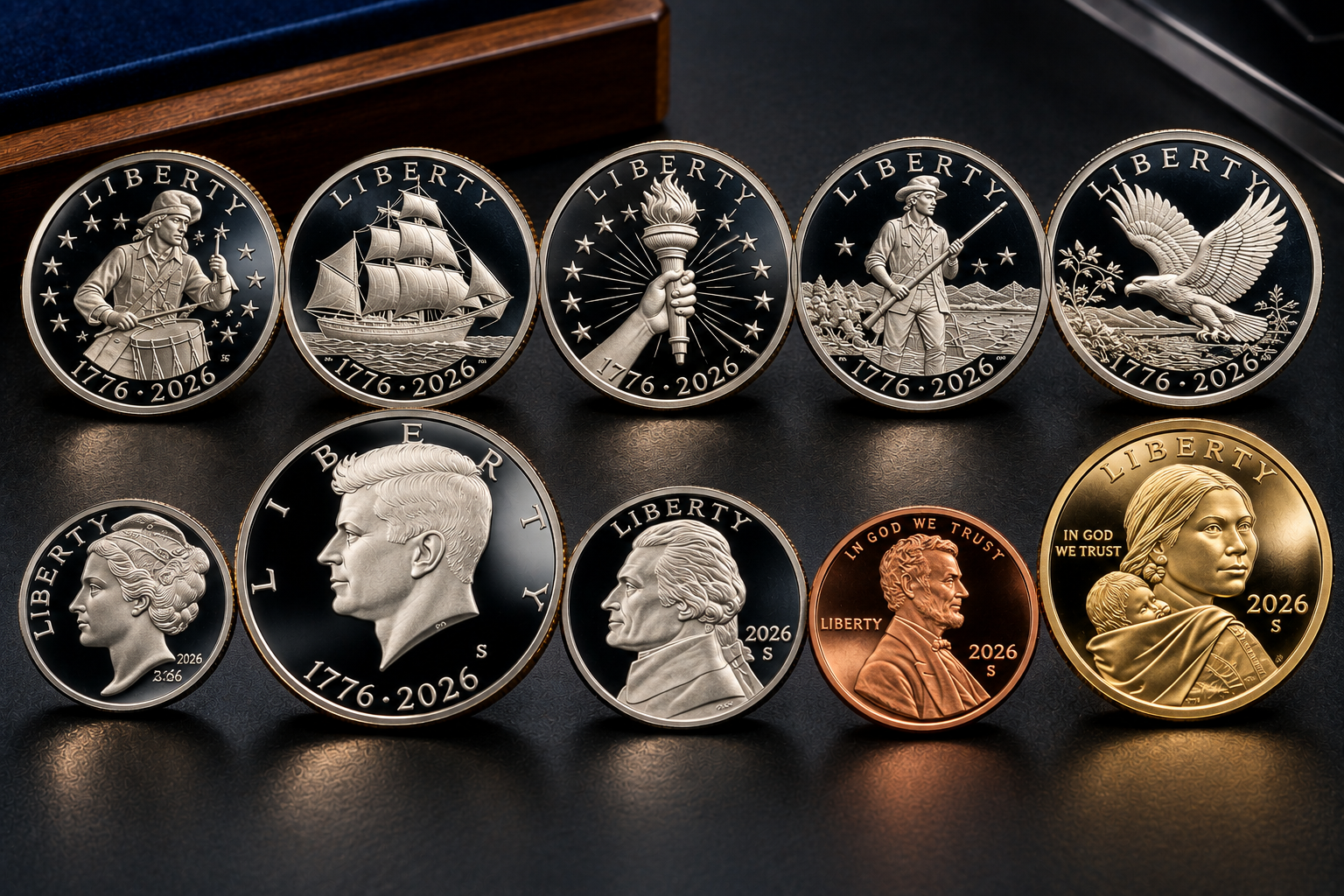
The 2026 United States Mint Proof Set is not an ordinary annual set with a different date stamped onto familiar coins. Created for the nation’s 250th anniversary year, it combines five completely different Semiquincentennial quarters with one-year designs for the dime and half dollar, a collectible Lincoln penny, a Jefferson nickel, and the 2026 Native American dollar.
That gives collectors much more to examine than the mirror-like surfaces normally associated with a Proof Set. Some of the biggest changes are in the designs themselves. The five quarters even change their obverses, while Liberty returns to the dime and replaces the familiar Kennedy imagery on the half dollar with a Statue of Liberty design.
The United States Mint currently schedules the set for release on October 6, 2026, at noon Eastern Time. It lists 10 San Francisco proof coins, all carrying the S mint mark, with a current product limit of 480,000 sets. But before thinking about numbers, packaging, or potential collectibility, there is a better way to approach this unusual set: read the coins themselves.
What This Article Explains
- Which 10 coins are included in the 2026 Semiquincentennial Proof Set.
- Why the five 2026 quarters require more than a quick look at their reverses.
- What changed on the dime and half dollar for the anniversary year.
- Why the Lincoln penny has a different context in 2026.
- What to examine on the Native American $1 coin.
- How to read proof fields, frosted devices, and cameo contrast.
- Why Proof does not mean flawless.
- How the regular Proof Set differs from the 2026 Silver Proof Set.
Table of Contents
- What Exactly Comes in the 2026 Proof Set?
- Start With the Five Semiquincentennial Quarters
- Look for 1776 ~ 2026
- The Emerging Liberty Dime Is a Major Change
- The Enduring Liberty Half Dollar
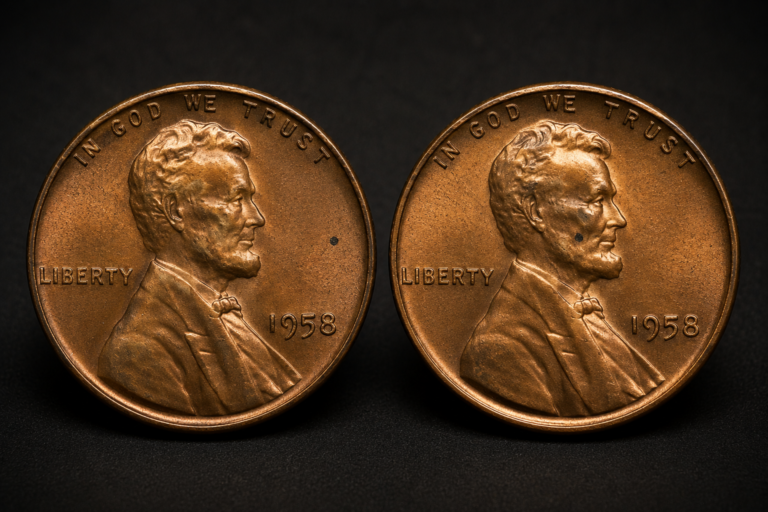
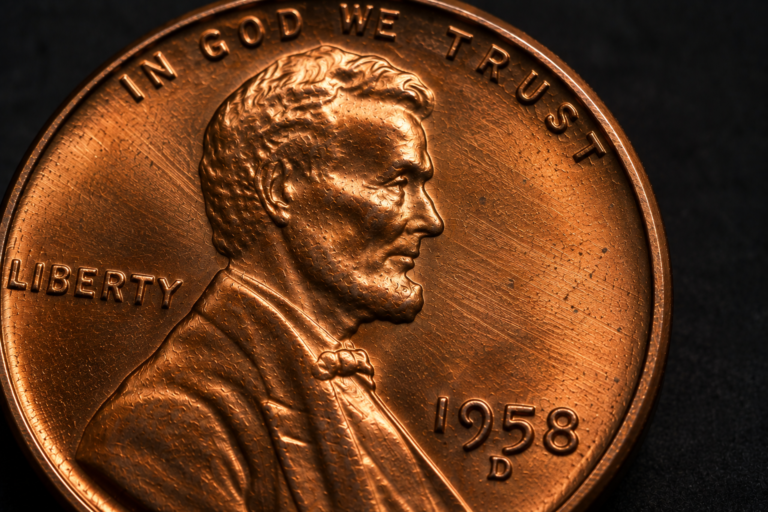
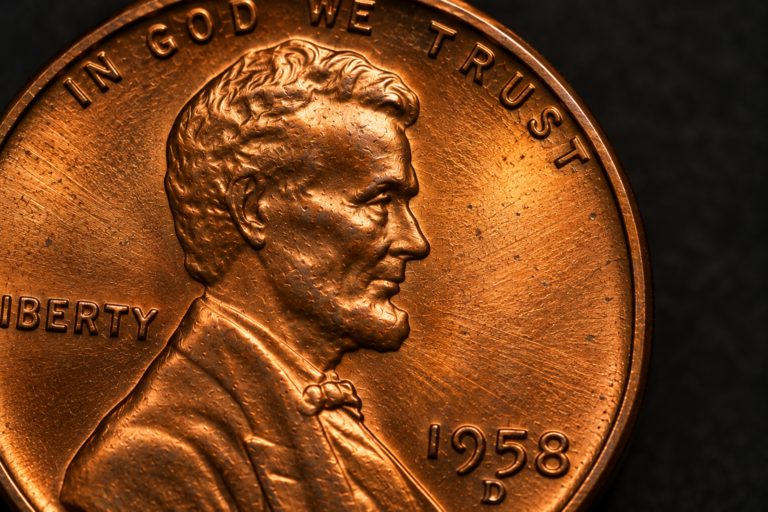
- Do Not Skip the Lincoln Penny
- The Jefferson Nickel Is Easy to Overlook
- Read the Native American $1 Coin Carefully
- Now Examine the Proof Surfaces
- Find the S Mint Mark
- Proof Does Not Mean Flawless
- Regular Proof Set vs Silver Proof Set
- The Collector’s 60-Second Examination
What Exactly Comes in the 2026 Proof Set?
The 2026 Semiquincentennial Proof Set contains 10 coins, but that does not mean it contains 10 denominations. Five of the coins are quarters, each with a different anniversary design.
The complete set consists of five Semiquincentennial quarters, one Emerging Liberty dime, one Enduring Liberty half dollar, one Jefferson nickel, one Lincoln penny, and one Native American $1 coin.
All 10 are proof coins produced at the United States Mint facility in San Francisco and carry the S mint mark. The Mint packages the coins in two clear plastic lenses and includes a certificate of authenticity.
The current U.S. Mint listing prices the set at $107 and gives it a product limit of 480,000, with no household order limit currently listed. Because the set has not yet reached its scheduled October 6 release date, collectors should remember that product details can still be updated by the Mint.
Start With the Five Semiquincentennial Quarters
The quarters are the visual center of this set, and the first thing to understand is that these are not simply five new reverse designs attached to one familiar obverse.
Each quarter represents a different historical theme, and the obverses change as well.
Mayflower Compact Quarter
The obverse shows two Pilgrims embracing as they behold the New World. The reverse depicts the Mayflower under full sails heading west across rough seas.
For collectors, this is a good example of why both sides need attention. The story is divided across the coin rather than concentrated on the reverse.
Revolutionary War Quarter
George Washington appears on the obverse as Commander-in-Chief of the Continental Army. The reverse shows a Continental Army soldier at Valley Forge.
Instead of looking only for the historical subject, study how the proof finish separates the portrait and soldier from their reflective backgrounds. Fine uniform details can become particularly noticeable on a proof strike.
Declaration of Independence Quarter
Thomas Jefferson appears on the obverse, while the reverse depicts the Liberty Bell ringing. The bell’s famous crack is visible as part of the design.
This is exactly the kind of detail a collector should distinguish from damage. A line that belongs to the intended design should never be confused with a scratch simply because it is visually prominent.
U.S. Constitution Quarter
James Madison appears on the obverse. Independence Hall appears on the reverse alongside the prominent words WE THE PEOPLE.
Architecture provides a different examination challenge from a portrait. Look at the sharpness of the building’s small structural details and how those devices contrast with the proof field around them.
Gettysburg Address Quarter
Abraham Lincoln appears on the obverse. The reverse features two hands grasping each other and the inscription A NEW NATION CONCEIVED IN LIBERTY, drawn from the Gettysburg Address.
By the time you reach this fifth quarter, one lesson should be obvious: examining only the reverse would mean missing half of what makes the 2026 quarter program unusual.
Look for 1776 ~ 2026
One of the easiest anniversary details to identify on the five quarters is the dual date 1776 ~ 2026.
Do not treat it as decorative filler. It immediately places these designs within the 250th anniversary program and visually separates them from ordinary annual issues.
A useful exercise is to locate the anniversary date before studying tiny surface characteristics. Reading inscriptions, dates, mint marks, and major design elements first prevents collectors from becoming distracted by microscopic marks before they understand the coin they are examining.
This follows the same systematic approach described in how to read a coin step by step.
The Emerging Liberty Dime Is a Major Change
The dime deserves much more than a quick glance.
For the 2026 anniversary year, the Emerging Liberty dime introduces a one-year design featuring Liberty. According to the U.S. Mint, this marks the first appearance of Liberty on the obverse of a dime since 1945. The Roosevelt dime debuted in 1946.
That historical change makes the design itself more important than the initial impression created by the proof finish.
When examining it, temporarily ignore the mirror-like field. Read the composition first. Find Liberty, study the inscriptions, and understand how different the coin is from the Roosevelt dime familiar to generations of Americans.
Then return to the surface and study the contrast between the frosted devices and reflective fields.
The Enduring Liberty Half Dollar
The half dollar makes another dramatic departure from a familiar American coin.
For this one-year anniversary issue, the usual John F. Kennedy portrait and Presidential Coat of Arms are replaced by the Enduring Liberty design depicting the Statue of Liberty.
For a collector accustomed to Kennedy half dollars, the most useful first question is simple: what familiar elements have disappeared, and what replaced them?
That comparison helps you read the coin as a new design instead of treating it as an ordinary Kennedy half dollar with an anniversary modification.
The larger diameter of the half dollar also gives collectors a useful surface on which to examine proof contrast and broad reflective areas. As explained in why broad fields deserve careful examination, open surfaces can make subtle marks and changes in reflectivity easier to detect.
Do Not Skip the Lincoln Penny
The Lincoln penny may initially appear less surprising than the new dime, half dollar, or quarters, but its 2026 context is historically unusual.
The U.S. Mint states that it struck the final one-cent coins intended for circulation in fall 2025, ending production of pennies for everyday commerce. The Mint also states that it will continue producing numismatic, or collectible, pennies for products including the Proof Set, Silver Proof Set, and Uncirculated Set.
That means the 2026-S Lincoln penny in this set should not be interpreted as a normal circulating penny simply placed inside special packaging. It belongs to the Mint’s continuing numismatic production.
This distinction is important because headlines about the end of circulating penny production can easily create the false impression that no Lincoln cents will exist with later dates.
The Jefferson Nickel Is Easy to Overlook
With five special quarters and major design changes on the dime and half dollar, the Jefferson nickel can disappear into the background.
That makes it a useful test of disciplined examination.
Do not skip a coin simply because another piece in the set has a more dramatic design. Locate the date and S mint mark, examine the proof fields, and compare the quality of the frosted devices with the other denominations.
A collector should learn to examine what is actually present, not only what attracts attention first.
Read the Native American $1 Coin Carefully
The 2026 Native American $1 coin follows its own program rather than simply repeating one of the Semiquincentennial quarter themes.
The obverse retains Sacagawea carrying her infant son Jean-Baptiste. The reverse honors Polly Cooper and the Oneida people’s assistance to the Continental Army at Valley Forge.
Polly Cooper is shown holding a basket as she shares the Oneidas’ gift of corn with General Washington. The reverse includes the inscription ONEIDA ALLIES AT VALLEY FORGE.
The dollar also differs physically from several other coins in the set because it has a lettered edge. That makes the edge part of the examination rather than an area to ignore.
Now Examine the Proof Surfaces
Only after reading the designs should you allow the spectacular proof finish to dominate your attention.
Proof coins are specially manufactured collector coins. Their appearance commonly emphasizes sharp detail, highly reflective fields, and frosted devices that can create strong cameo contrast.
Begin with the whole coin before chasing tiny imperfections. This is the same principle behind starting with the whole coin before chasing tiny details.
Next, use controlled directional light. Watch the reflective fields rather than judging them from a single bright flash. Change the viewing angle slowly and compare the surfaces around major devices.
The goal is not merely to ask whether the coin is shiny. Look for consistency. Are the fields clear and strongly reflective? Do the frosted devices remain visually distinct? Are there distracting spots, haze, or marks that interrupt the appearance?
Directional light can reveal subtle surface changes, while changing the viewing angle helps explain reflective surfaces that can look completely different from one position to another.
Find the S Mint Mark
Every coin in the set is listed by the U.S. Mint as a San Francisco proof carrying the S mint mark.
Make locating that mark part of your routine.
Before magnification, find the date, denomination, major inscriptions, and mint mark. Doing this on all 10 coins forces you to read each piece rather than simply admiring the set as one display.
It also helps reinforce an important collecting habit: identify the coin first, evaluate its surface second.
Proof Does Not Mean Flawless
One of the most important distinctions in the entire set is the difference between a Proof coin and a perfect coin.
Proof describes a specially produced numismatic coin and its method of manufacture. It is not a numerical grade.
A proof coin can still show imperfections. Collectors may encounter spots, haze, small marks, or other visual distractions. Packaging can also affect what appears visible through a plastic lens.
That is why one photograph is not enough to establish every subtle surface characteristic. As discussed in why one photograph cannot reveal every surface characteristic, reflective coins are especially sensitive to lighting and viewing angle.
And most importantly, do not call every unusual spot, line, or reflective patch a Mint error. A genuine mint error requires evidence connected to the minting process, not simply an unexplained visual feature.
Regular Proof Set vs Silver Proof Set
Collectors should also avoid confusing the regular 2026 Semiquincentennial Proof Set with the separate 2026 Semiquincentennial Silver Proof Set.
In the regular set discussed here, the dime, quarters, and half dollar use their listed copper-nickel clad compositions. The separate Silver Proof Set uses 99.9 percent silver for those denominations.
The designs may create an obvious visual relationship between the products, but their metallic compositions are not the same.
| Coin | What Makes 2026 Different | What Collectors Should Examine |
|---|---|---|
| Mayflower Compact Quarter | Special anniversary obverse and reverse | Pilgrims, Mayflower, dual date, proof contrast |
| Revolutionary War Quarter | Washington and Valley Forge theme | Portrait, soldier detail, inscriptions, fields |
| Declaration of Independence Quarter | Jefferson and Liberty Bell | Bell detail, intended crack, proof surfaces |
| U.S. Constitution Quarter | Madison and Independence Hall | Architectural detail, lettering, cameo contrast |
| Gettysburg Address Quarter | Lincoln and Gettysburg theme | Portrait, hands, inscriptions, field quality |
| Emerging Liberty Dime | One-year Liberty design | New design, small details, proof contrast |
| Enduring Liberty Half Dollar | Statue of Liberty replaces familiar Kennedy imagery | Large devices, open fields, reflective consistency |
| Jefferson Nickel | Part of the special 2026 annual set | Date, S mint mark, fields, frosted devices |
| Lincoln Penny | Collectible issue after circulating penny production ended | Date, S mint mark, proof surface quality |
| Native American $1 | Polly Cooper and Oneida allies reverse | Reverse details, Sacagawea obverse, lettered edge |
The Collector’s 60-Second Examination
Start by confirming that the set contains all 10 coins. Separate the five quarters mentally from the other five pieces and identify each historical quarter theme.
Next, examine both sides of the quarters. Do not make the common mistake of treating them as a five-reverse program.
Find the anniversary dates and S mint marks. Move to the Emerging Liberty dime and Enduring Liberty half dollar and concentrate on the design changes before studying their reflective surfaces.
Give the Lincoln penny and Jefferson nickel the same attention. Then examine the Native American dollar, including its edge.
Finally, use directional light to compare the proof surfaces across the set. Look at the fields, frosted devices, contrast, sharpness, and overall consistency. If a spot or mark attracts your attention, change the viewing angle before deciding what you are seeing.
The process takes longer than simply admiring the mirror finish, but it turns the set from a display object into something you can actually read.
Reality Check
A special one-year design does not automatically make every individual coin rare. The 250th anniversary theme, new designs, and unusual status of the 2026 penny give the set historical and collecting interest, but rarity depends on factors such as actual production, surviving population, demand, condition, and the specific coin or product being discussed. Anniversary language alone is not evidence of rarity or future value.
“Don’t let the mirror finish distract you. In 2026, the designs themselves are part of the story.”
Final Verdict
The best way to understand the 2026 Semiquincentennial Proof Set is to treat it as more than another annual Proof Set. Read the five quarters individually and remember that their obverses change as well as their reverses. Study Liberty’s return to the dime, the Statue of Liberty on the one-year half dollar, the unusual numismatic context of the Lincoln penny, and the Polly Cooper reverse of the Native American dollar. Then examine what makes the set a proof product: reflective fields, frosted devices, sharp detail, and the S mint marks of San Francisco. The result is a set that rewards two kinds of attention at once. First read the designs and understand what changed in 2026. Then read the surfaces like a collector.
Frequently Asked Questions
How many coins are in the 2026 Semiquincentennial Proof Set?
The set contains 10 proof coins: five different Semiquincentennial quarters, an Emerging Liberty dime, an Enduring Liberty half dollar, a Jefferson nickel, a Lincoln penny, and a Native American $1 coin.
Where are the 2026 Semiquincentennial Proof Set coins made?
The U.S. Mint lists all 10 coins as San Francisco proof issues carrying the S mint mark.
When will the 2026 Semiquincentennial Proof Set be released?
The U.S. Mint currently schedules the set to go on sale on October 6, 2026, at 12 noon Eastern Time. The current listing shows a price of $107 and a product limit of 480,000 sets. Because these are pre-release product details, collectors should check the U.S. Mint listing for any later changes.
Is the regular 2026 Semiquincentennial Proof Set made of silver?
No. The regular Proof Set uses the listed clad compositions for the dime, quarters, and half dollar. The separate 2026 Semiquincentennial Silver Proof Set uses 99.9 percent silver for those denominations.