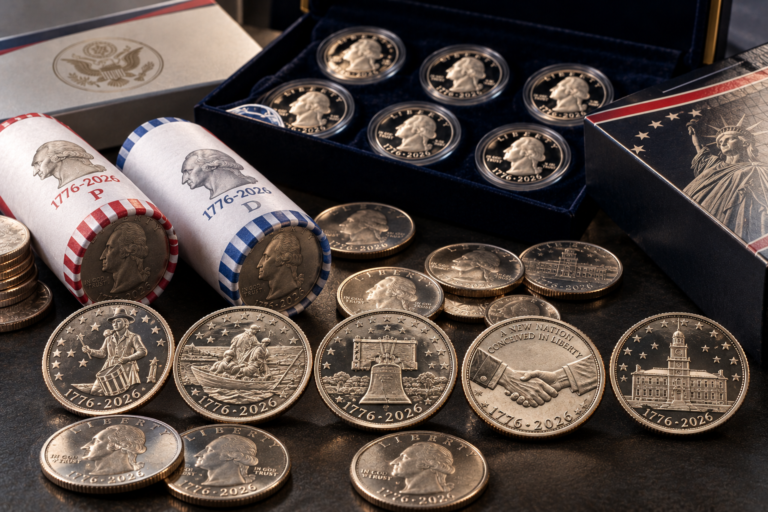
2026 Morgan and Peace Dollars: How to Identify the New Diamond Field Finish
The Morgan dollar’s familiar Liberty portrait has not been redesigned. Neither has the Peace dollar’s radiant Liberty. Yet the United States Mint is preparing a version of both coins that looks different from anything previously issued in the modern series. The change is not primarily in the portraits or the eagles. It is in the metal surrounding them.
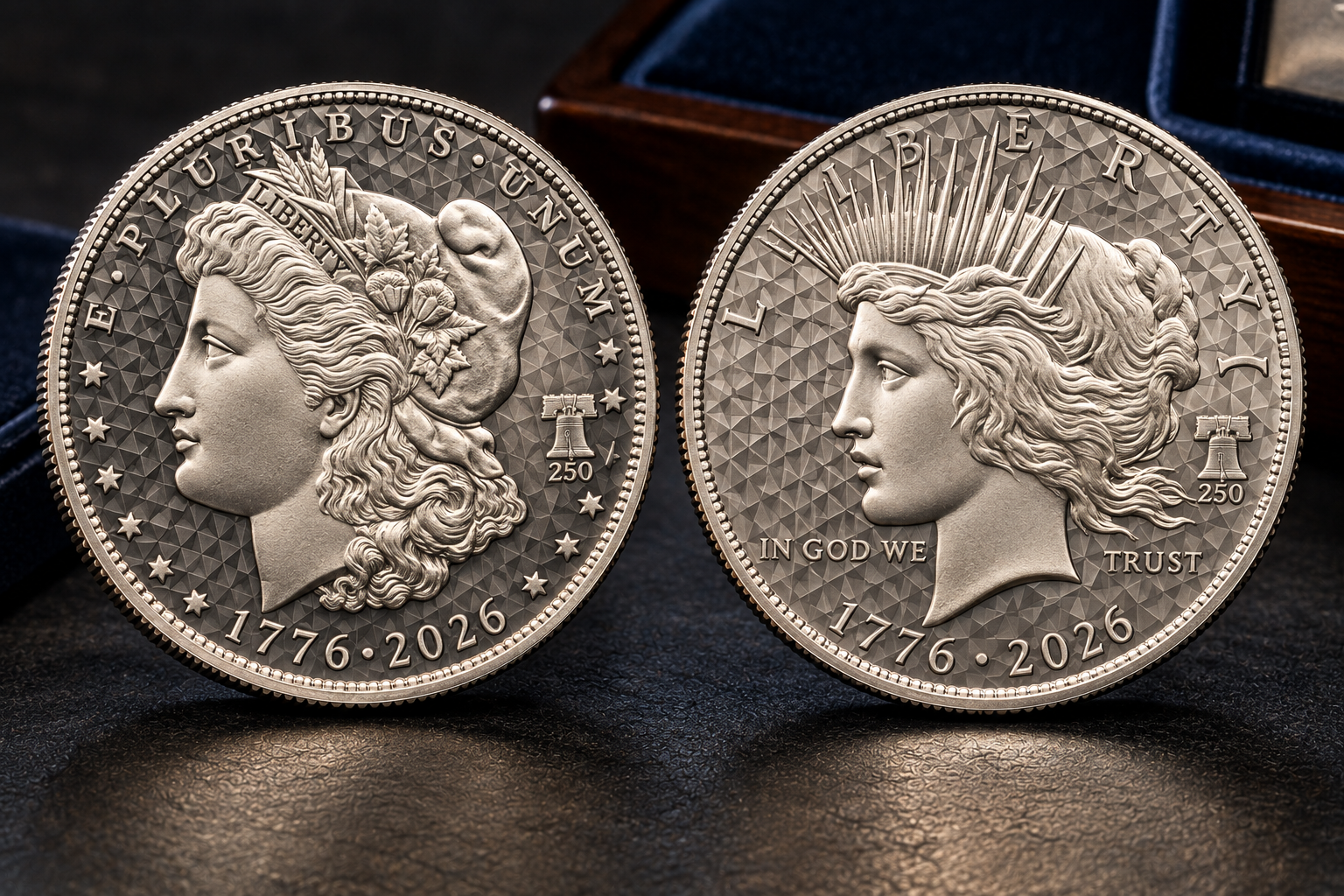
The 2026 Morgan and Peace Dollar Diamond Field Two-Coin Set introduces a new finish featuring repeating diamond-shaped patterns across the coin fields. Created for America’s 250th anniversary, the finish gives two classic silver dollar designs an unusual surface treatment that collectors will need to examine differently from traditional Proof and Reverse Proof coins.
The set is scheduled for November 12, 2026, at noon Eastern Time. Both coins are struck in 99.9% fine silver at the Philadelphia Mint and carry the anniversary date 1776 ~ 2026, along with a Liberty Bell privy mark containing the number 250.
But what exactly makes Diamond Field different? Where should collectors examine the pattern, and how can they distinguish these coins from the other Morgan and Peace dollars released during 2026?
What This Article Explains
- What is included in the 2026 Morgan and Peace Diamond Field Two-Coin Set.
- How the new Diamond Field finish changes the appearance of the coin surfaces.
- Why Diamond Field is different from traditional Proof and Reverse Proof finishes.
- Where to examine the pattern on the Morgan and Peace dollar designs.
- How to identify the 1776 ~ 2026 date, Philadelphia mint mark, and Liberty Bell 250 privy mark.
- How to distinguish Diamond Field coins from other 2026 Morgan and Peace releases.
- What collectors should know about the announced price, production limits, and potential market value.
Table of Contents
- What Is the 2026 Diamond Field Two-Coin Set?
- What Exactly Is a Diamond Field Finish?
- Diamond Field vs Proof vs Reverse Proof
- The 2026 Morgan Dollar: Where to Examine the Pattern
- The 2026 Peace Dollar: A Different Test for the Same Finish
- Why Both Coins Carry 1776 ~ 2026 and a 250 Privy Mark
- How to Tell Diamond Field Apart From Other 2026 Dollars
- What Collectors Should Examine Under Light
- Does a New Finish Make These Coins Rare?
- The Collector’s 60-Second Examination
- Frequently Asked Questions
What Is the 2026 Diamond Field Two-Coin Set?
The United States Mint’s 2026 Diamond Field release brings together two of the country’s most recognizable silver dollar designs in a single collector set.
The Morgan dollar, originally introduced in 1878, reflects an era of American industrial growth and westward expansion. The Peace dollar, first issued in 1921, emerged after World War I and became associated with the hope for lasting peace.
Both designs returned to modern U.S. Mint production in 2021, giving collectors contemporary versions of coins that had long been central to American numismatics.
For 2026, the Mint is using the nation’s Semiquincentennial as the occasion to introduce a new surface finish to both designs.
The Diamond Field Two-Coin Set carries U.S. Mint product number 26XS and is scheduled to become available on November 12, 2026, at 12 noon Eastern Time.
According to the official product listing reviewed in October 2026, the set is priced at $375. The Mint lists a mintage limit and product limit of 262,500, with no household order limit.
The coins are packaged together in a blue presentation box and accompanied by a certificate of authenticity.
| Specification | 2026 Morgan Dollar | 2026 Peace Dollar |
|---|---|---|
| Denomination | $1 | $1 |
| Finish | Diamond Field | Diamond Field |
| Composition | 99.9% silver | 99.9% silver |
| Silver weight | 0.859 troy ounce | 0.859 troy ounce |
| Diameter | 38.10 mm | 38.10 mm |
| Mint | Philadelphia | Philadelphia |
| Mint mark | P | P |
| Edge | Reeded | Reeded |
| Anniversary date | 1776 ~ 2026 | 1776 ~ 2026 |
| Privy mark | Liberty Bell 250 | Liberty Bell 250 |
Each coin contains 0.859 troy ounce of silver, giving the two-coin set a combined silver weight of 1.718 troy ounces.
These are collector products, not circulating dollar coins intended for everyday transactions.
What Exactly Is a Diamond Field Finish?
To understand the new finish, it helps to separate two parts of a coin that collectors often examine together.
The devices are the raised design elements, such as Liberty’s portrait, the eagle, lettering, and other relief details. The fields are the background areas surrounding those elements.
On the 2026 Diamond Field dollars, the Mint has introduced a repeating diamond-shaped pattern into the fields.
That pattern is the defining visual characteristic of the finish.
The United States Mint describes Diamond Field as a new finish produced through a striking process developed specifically for the Semiquincentennial. Its October 2026 publication presents the finish as something not previously used on a U.S. coin.
The important distinction is that the pattern is part of the intended surface appearance. It is not a collection of scratches, a decorative coating applied by a private company, or a set of actual gemstones embedded in the silver.
Collectors familiar with traditional Proof coins may initially expect broad, smooth, mirror-like fields. Diamond Field changes that expectation.
Instead of treating the background as a visually plain surface, the new finish makes the field itself an important design feature.
This is especially interesting because the Morgan and Peace dollars already contain elaborate relief details. The new finish introduces another visual element without replacing their historic designs.
“The defining feature of the 2026 Diamond Field dollars is not a new Liberty portrait. It is the patterned silver surrounding the familiar design.”
Diamond Field vs Proof vs Reverse Proof
Diamond Field is easier to understand when compared with two finishes that modern collectors already recognize.
A traditional Proof coin commonly features reflective fields and frosted raised devices. This contrast helps the portrait, eagle, and lettering stand out against a mirror-like background.
Reverse Proof reverses that familiar relationship. Its raised devices typically appear reflective against frosted fields.
Diamond Field introduces a different visual treatment by placing a repeating pattern within the background areas.
| Feature | Traditional Proof | Reverse Proof | Diamond Field |
|---|---|---|---|
| Field appearance | Typically mirror-like | Typically frosted | Repeating diamond pattern |
| Raised devices | Typically frosted | Typically reflective | Contrast with patterned fields |
| Primary visual effect | Mirror and frost contrast | Reversed contrast | Patterned background treatment |
| Collector examination | Mirrors, frost, and surface marks | Reflective devices and frosted fields | Pattern appearance and design definition |
These descriptions explain the general appearance of the finishes rather than every technical step involved in producing them.
The Mint has identified Diamond Field as its own finish category. Collectors should therefore avoid describing it as simply another name for Reverse Proof.
For a useful comparison, consider the 2026 American Innovation Reverse Proof Set. Those dollars use a finish that emphasizes reflective raised elements against frosted backgrounds.
The Morgan and Peace Diamond Field coins approach the relationship between design and background differently.
Both releases demonstrate how a change in finish can alter the appearance of a familiar coin without requiring an entirely new design.
The 2026 Morgan Dollar: Where to Examine the Pattern
The Morgan dollar provides an especially interesting surface for the Diamond Field treatment because its design contains numerous small details surrounded by carefully balanced background areas.
George T. Morgan’s obverse features Liberty facing left, wearing a cap decorated with agricultural elements and a crown bearing the word LIBERTY.
Thirteen stars, E PLURIBUS UNUM, and the anniversary date 1776 ~ 2026 surround the portrait.
The reverse shows an eagle with outstretched wings, holding arrows and an olive branch. A wreath frames the lower portion of the composition.
For the Diamond Field version, begin by examining the background around Liberty’s portrait.
Notice the space between the portrait and the surrounding stars. This is an area where the new field treatment should be easier to recognize than in crowded parts of the design.
Then move toward the lettering and date. The small spaces around individual characters provide another opportunity to observe the relationship between raised details and the patterned background.
On the reverse, examine the areas around the eagle’s wings, body, and surrounding inscriptions.
The purpose is not to search immediately for an error. It is to understand how the repeating pattern interacts with the familiar Morgan dollar design.
Once the coins become available for direct examination, collectors will be able to assess how clearly the pattern appears under different lighting conditions and whether the raised details remain visually distinct.
The 2026 Peace Dollar: A Different Test for the Same Finish
The Peace dollar offers a contrasting design environment.
Anthony de Francisci’s Liberty portrait features a radiant crown, with rays extending outward from the head. The obverse inscriptions include LIBERTY, IN GOD WE TRVST, and the anniversary date.
The reverse shows an eagle at rest, holding an olive branch above the word PEACE.
Compared with the Morgan dollar’s elaborate eagle and wreath, the Peace dollar’s reverse has a more restrained composition.
That difference matters when studying the Diamond Field finish.
On the obverse, the radiating elements of Liberty’s crown create narrow spaces between raised details. These areas may offer a useful contrast with the repeating field pattern.
On the reverse, the background surrounding the eagle provides a broader area for observing the new surface treatment.
Collectors should compare the Peace dollar’s larger background areas with the more crowded portions of the Morgan dollar.
It is a practical way to see how the same finish interacts with two different artistic compositions.
Neither design is automatically better suited to Diamond Field. That judgment will depend on individual preferences and what collectors observe when examining actual examples.
Why Both Coins Carry 1776 ~ 2026 and a 250 Privy Mark
The Diamond Field finish is not the only feature connecting these dollars to the nation’s 250th anniversary.
Both coins carry the dual date 1776 ~ 2026, replacing the ordinary single-year presentation with an explicit reference to the Semiquincentennial.
They also feature a Liberty Bell privy mark containing the number 250.
The privy mark is a small commemorative feature separate from the P mint mark.
The P identifies the Philadelphia Mint as the facility where the coins were struck. The Liberty Bell and 250 marking recognizes the anniversary.
Collectors should not confuse the two.
Nor should they assume that the Liberty Bell 250 privy mark is exclusive to the Diamond Field set. The Mint has used anniversary markings across multiple 2026 numismatic releases.
Another example is the 2026 9/11 Enduring Liberty half dollar comparison, where special privy marks help distinguish different commemorative issues.
The broader lesson is that a privy mark can identify a special theme or issue, while the mint mark identifies the production facility.
How to Tell Diamond Field Apart From Other 2026 Morgan and Peace Dollars
The year 2026 includes more than one Morgan and Peace dollar finish, which makes accurate identification particularly important.
The Mint released individual Reverse Proof Morgan and Peace dollars in July. Those coins were struck at Philadelphia and carry P mint marks.
Enhanced Uncirculated versions were also issued during 2026, struck at West Point with W mint marks.
The Diamond Field coins form a separate two-coin release scheduled for November.
Because the basic Morgan and Peace designs remain recognizable across these products, the date and portrait alone are not enough to identify the finish.
Look for the intended surface treatment, verify the mint mark, and consider the coin’s original packaging and documentation.
A certificate of authenticity and original Mint packaging can provide useful supporting evidence about which product a coin came from, although packaging alone should never replace examination of the coin itself.
For the Diamond Field set, the defining feature is the patterned background treatment.
What Collectors Should Examine Under Light
Lighting will play an important role in examining the Diamond Field finish, just as it does with traditional Proof and Reverse Proof coins.
However, the goal should be to understand the intended pattern before judging possible surface problems.
Begin with a stable, directional light source. Avoid lighting that is so bright that reflections overwhelm the details.
Observe the field at a comfortable viewing distance. Then slowly change the angle of the coin or light.
Watch how the diamond-shaped pattern becomes more or less visible.
Next, examine the boundaries between the raised devices and the background. On the Morgan dollar, concentrate on the portrait, stars, and eagle. On the Peace dollar, examine the radiant crown and the open areas around the resting eagle.
If you notice an unusual bright area or apparent interruption in the pattern, do not immediately call it an error.
Reflections, photography, and the viewing angle can influence how a textured surface appears.
Once actual collector examples are available, comparing multiple coins under identical conditions may help distinguish normal visual behavior from genuine differences between individual pieces.
Until then, official Mint photographs are useful references for the intended appearance, but they cannot establish the condition of a particular coin that has not yet been examined.
Does a New Finish Make These Coins Rare?
The introduction of a new finish is significant from a numismatic standpoint, but it does not automatically establish rarity.
The United States Mint currently lists both the mintage limit and product limit for the 2026 Diamond Field Two-Coin Set at 262,500.
Those figures describe the announced limits, not the number of sets that have already sold.
Actual demand, final distribution, collector preferences, and the preservation of individual coins will all influence how the set is viewed over time.
The $375 official issue price also should not be treated as a prediction of future resale value.
Some collectors may be interested primarily in the first use of the Diamond Field finish. Others may collect every modern Morgan and Peace dollar issue or focus on Semiquincentennial products.
These are different collecting motivations, and they do not necessarily lead to the same market behavior.
It is also worth remembering that a new finish does not guarantee a perfect individual coin. Collectors should continue to evaluate surfaces, marks, and overall preservation rather than assuming that every example is identical.
Reality Check
Diamond Field is a newly introduced U.S. Mint finish, but novelty is not the same as rarity. The currently listed limit of 262,500 is not a final sales figure, and the announced $375 issue price does not establish future market value. As of October 2026, the set has not reached its scheduled November release, so claims about widespread production defects, unusually high certified grades, or actual collector-market premiums would be premature.
The Collector’s 60-Second Examination
When the set becomes available, a simple examination routine can help collectors understand the two coins without rushing to conclusions about quality or value.
- Confirm the product. Identify the Morgan and Peace Dollar Diamond Field Two-Coin Set and check the original Mint documentation.
- Check the date. Both coins should carry the anniversary date 1776 ~ 2026.
- Locate the mint marks. Confirm the P mint mark identifying Philadelphia.
- Find the privy marks. Look for the Liberty Bell and 250 anniversary feature.
- Examine the Morgan dollar fields. Observe the pattern around Liberty, the stars, and the eagle.
- Examine the Peace dollar fields. Study the background around the radiant crown and the resting eagle.
- Use consistent lighting. Compare both coins under the same light source and similar viewing angles.
- Evaluate condition separately. Do not confuse the intended diamond pattern with scratches, marks, or other surface disturbances.
After completing these steps, return to the two coins as a pair.
Notice how the same field treatment changes the visual character of two designs created decades apart.
That comparison is one of the strongest reasons to examine the set carefully rather than treating it only as another anniversary product.
Final Verdict
The 2026 Morgan and Peace Dollar Diamond Field Two-Coin Set introduces a new way to experience two classic American silver dollar designs.
The portraits and eagles remain familiar, but the repeating diamond-shaped pattern in the fields changes how the surrounding silver participates in the overall appearance of each coin.
The Morgan dollar offers intricate details and a complex reverse composition. The Peace dollar provides a different balance of radiant elements and open background areas. Together, they offer collectors a useful opportunity to compare how one new finish interacts with two distinct designs.
For anyone considering the November 12 release, the most important details are the Diamond Field treatment, Philadelphia P mint marks, 1776 ~ 2026 dates, and Liberty Bell 250 privy marks.
The finish is new, but the principles of careful coin examination remain the same: identify the issue correctly, study the surfaces under appropriate light, and separate documented Mint specifications from assumptions about future rarity or value.
Frequently Asked Questions
What is the Diamond Field finish on the 2026 Morgan and Peace dollars?
Diamond Field is a new United States Mint finish featuring a repeating diamond-shaped pattern in the background fields of the coins. The Mint developed the finish specifically for the nation’s 250th anniversary.
When will the 2026 Morgan and Peace Diamond Field set be released?
The U.S. Mint currently schedules the two-coin set for November 12, 2026, at 12 noon Eastern Time.
How much does the 2026 Diamond Field Two-Coin Set cost?
The official U.S. Mint product page lists the set at $375 as of October 2026. Pricing may be subject to change before release.
Are the 2026 Diamond Field Morgan and Peace dollars made of silver?
Yes. Both coins are struck in 99.9% fine silver. Each contains 0.859 troy ounce of silver, giving the set a combined silver weight of 1.718 troy ounces.
Are Diamond Field and Reverse Proof the same finish?
No. Reverse Proof generally features reflective raised devices against frosted fields. Diamond Field is a separate Mint finish distinguished by its repeating diamond-shaped background pattern.
Where were the 2026 Diamond Field dollars minted?
Both coins were struck at the Philadelphia Mint and carry P mint marks.
Do the 2026 Diamond Field dollars have a special privy mark?
Yes. Both coins feature a Liberty Bell privy mark containing the number 250, commemorating the 250th anniversary of American independence.
Does the Diamond Field finish make the coins valuable?
Not automatically. The finish is a documented numismatic innovation, but future value will depend on collector demand, availability, preservation, and market conditions. The official issue price and announced production limits do not guarantee a particular resale value.
Official U.S. Mint References
For the latest product details and information about the new finish, consult the following official sources: