Why Are So Many 2026 U.S. Mint Coins Unavailable? Sold Out vs. Rare Explained
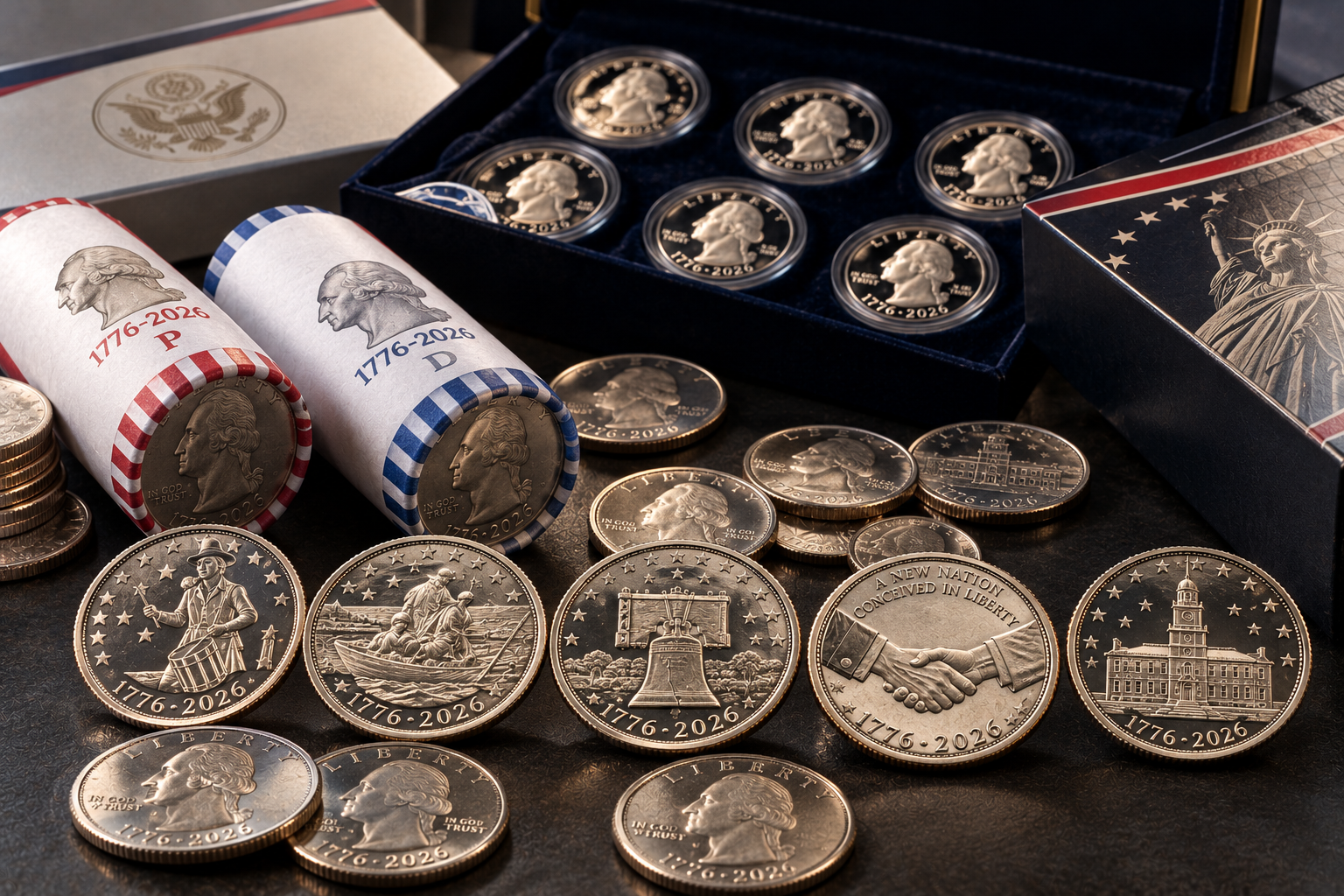
A collector visits the United States Mint website looking for a roll of 2026 quarters. The product is listed, the design is familiar, and the price is visible. But there is no way to place an order. The coins are marked unavailable.
That experience has become surprisingly common during America’s 250th anniversary year. In a September 20, 2026, review, CoinNews found that 50 of the 75 U.S. Mint products released during the year were unavailable for direct purchase. Among circulating-quality coin rolls and bags, 37 of 38 options were unavailable.
Those numbers are striking, but they do not mean that two-thirds of all 2026 coins are rare. They describe the availability of specific products at a particular point in time, not the total number of coins produced or the quantity surviving in collectors’ hands.
The difference matters. A coin roll can disappear from the Mint’s online store while the same underlying coins remain obtainable through circulation, dealers, other collector products, or the secondary market. And a product marked Currently Unavailable is not necessarily gone forever.
Understanding what these labels mean is the first step toward deciding whether an unavailable 2026 coin product deserves a premium price.
What This Article Explains
- How many 2026 U.S. Mint products were unavailable in the September review.
- What Currently Unavailable, Sold Out, and Back Order actually mean.
- Why 2026 quarter rolls and bags have been particularly difficult to order.
- How product availability differs from the rarity of an individual coin.
- Why mintage limits, product limits, and sales figures should not be confused.
- Whether unavailable products can return to the Mint’s store.
- What collectors should verify before paying more than the original issue price.
Table of Contents
- How Many 2026 U.S. Mint Products Became Unavailable?
- What Does Currently Unavailable Actually Mean?
- Why Are 2026 Quarter Rolls and Bags Hard to Order?
- The Difference Between a Sold-Out Product and a Rare Coin
- Can Unavailable U.S. Mint Products Come Back?
- Mintage Limits, Product Limits, and Sales Figures
- What Recent 2026 Releases Tell Collectors
- Does Sold Out Mean a Coin Will Increase in Value?
- What to Check Before Paying a Premium
- How to Track U.S. Mint Product Availability
- Frequently Asked Questions
How Many 2026 U.S. Mint Products Became Unavailable?
On September 20, 2026, CoinNews published a review of the United States Mint’s product availability. Of 75 products released up to that point in the year, 50 were unavailable for purchase directly from the Mint.
That represented 66.7% of the reviewed lineup.
The situation was even more pronounced among circulating-quality rolls and bags. Of 38 individual options released, 37 were unavailable, leaving only one orderable option in that category at the time.
| Product Category | Unavailable | Total Reviewed | Unavailable Rate |
|---|---|---|---|
| All reviewed 2026 products | 50 | 75 | 66.7% |
| Circulating-quality rolls and bags | 37 | 38 | 97.4% |
These figures were not isolated from the rest of the year. An April 4 review found 16 of 23 products unavailable. In August, the figure was 39 of 64.
However, those percentages cannot be treated as a simple measurement of demand increasing every month. New products were continually entering the lineup, and some had larger production limits or longer sales periods than others.
The September report also excluded the special Philadelphia 9/11 half-dollar preorder products from its main availability calculation because those products were offered through a fixed preorder window.
That distinction is important when interpreting the numbers. A temporary preorder, a product with a defined sales period, and a regular inventory listing do not operate under identical conditions.
Most importantly, the September figures are a historical snapshot. They should not be mistaken for the exact status of every product in late October or beyond.
What Does Currently Unavailable Actually Mean?
The U.S. Mint uses several inventory labels that may appear similar to customers but have different meanings.
Three labels are especially important: Back Order, Currently Unavailable, and Sold Out.
| U.S. Mint Status | Official Meaning | What Collectors Should Understand |
|---|---|---|
| Back Order | The product can still be ordered, but no inventory is currently in stock and a future shipping date is displayed. | The Mint is accepting orders even though shipment will occur later. |
| Currently Unavailable | No inventory remains in the warehouse and no additional production is currently scheduled. Additional inventory may become available. | The product cannot be ordered now, but its status is not necessarily final. |
| Sold Out | The product is no longer in stock and is no longer available for sale. | The Mint has ended direct availability of that product. |
These definitions come from the U.S. Mint’s official product FAQ.
For collectors, the key distinction is that Currently Unavailable does not carry the same final meaning as Sold Out.
The Mint specifically notes that additional inventory may become available for a product marked Currently Unavailable. Customers who request notifications may receive a message if the product returns.
Back Order is different again. In that case, the product remains orderable even though immediate shipment is not possible.
Confusing these labels can lead collectors to overestimate how difficult a product will be to obtain.
Why Are 2026 Quarter Rolls and Bags Hard to Order?
The 2026 quarter program is unusually appealing to collectors because it replaces the normal annual design lineup with five special reverses celebrating major moments in American history.
The designs honor the Mayflower Compact, Revolutionary War, Declaration of Independence, U.S. Constitution, and Gettysburg Address.
They are part of the nation’s Semiquincentennial coinage, which also features special designs and anniversary elements on other denominations.
Collectors who want examples from both Philadelphia and Denver may seek individual rolls, 100-coin bags, or paired roll sets.
That creates demand for particular product configurations, not merely for the underlying coin design.
By September 20, CoinNews reported that every roll-and-bag option released for the first four Semiquincentennial quarter designs was unavailable.
The same report showed that all released American Innovation dollar roll-and-bag options for Iowa, Wisconsin, California, and Minnesota were unavailable as well.
One-year designs, the dual date 1776 ~ 2026, and commemorative features provide plausible reasons for strong collector interest. But an unavailable listing by itself cannot establish exactly how much of the change was caused by demand rather than inventory planning or production limits.
The Mint has also stated that availability of circulating coin products depends on its production schedule, circulating coin demand, and available supply. Products may become unavailable without remaining on sale for the entire calendar year.
That helps explain why collector demand and distribution logistics must be considered together.
The Difference Between a Sold-Out Product and a Rare Coin
This is where the distinction becomes especially important.
Imagine that the Mint offers a 100-coin bag containing a particular 2026 quarter design. The bag becomes unavailable after collectors purchase the allocated inventory.
What has disappeared from the Mint’s store is that specific bag product.
It does not follow that every quarter of the same design and mint mark is now rare.
Additional examples may exist in circulating coin distribution, other Mint products, dealer inventories, or private collections.
Even when a particular package has a relatively low product limit, the coins inside it may belong to a much larger overall production.
Consider a simplified example. If 5,000 bags each contain 100 quarters, those bags account for 500,000 individual coins. But that calculation tells us only how many coins were included in that product allocation. It does not establish the total number of that quarter design produced through every distribution channel.
Product scarcity and coin scarcity are related concepts, but they are not interchangeable.
A sealed Mint package might attract a different kind of collector demand from an individual loose coin. Original packaging, provenance, and product completeness can influence interest without changing the identity of the underlying coin.
“An unavailable Mint product tells you something about the product’s supply. It does not automatically tell you how rare the coin inside it is.”
Can Unavailable U.S. Mint Products Come Back?
Yes. The Mint’s official definition of Currently Unavailable explicitly allows for additional inventory to become available later.
That inventory may arise through changes in fulfillment, released stock, or other circumstances. Collectors should not assume that every temporary disappearance represents the end of sales.
During 2026, some products moved between available and unavailable status.
CoinNews reported that the 1804 Silver Dollar Gold Coin and Silver Medal Set briefly became unavailable after its August launch before returning to sale. The Mercury Dime Gold Coin and Silver Medal Set also moved on and off sale more than once.
These examples illustrate why the date of an availability report matters.
A product described as unavailable in one article may have a different status when a collector checks the official listing days or weeks later.
That does not mean the original report was wrong. It means inventory is dynamic.
Collectors should also distinguish an item returning to stock from the Mint authorizing an entirely new production run. The two are not necessarily the same event.
Mintage Limits, Product Limits, and Sales Figures
Another common source of confusion involves the numbers printed on U.S. Mint product pages.
A mintage limit, a product limit, and a sales figure answer different questions.
| Term | What It Describes | What It Does Not Prove |
|---|---|---|
| Mintage Limit | The maximum number of coins authorized for the applicable issue. | That the maximum number was actually produced or sold. |
| Product Limit | The maximum number of a particular packaged product offered. | That the coins exist only in that package. |
| Reported Sales | The quantity reported sold at a specified reporting date. | The final number of surviving coins or packages. |
| Circulation Production | Coins produced for circulation or related distribution channels. | The quantity allocated to a particular collector product. |
Suppose a product has a limit of 10,000 sets and reported sales of 9,800. The figures suggest that sales are approaching the stated product limit.
They do not prove that all 10,000 sets have been sold, that the product cannot return, or that the individual coins will become rare.
Reported sales may also change as orders are processed, canceled, returned, or adjusted.
For that reason, collectors should always record the date attached to a sales figure.
A number without its reporting date can be misleading, particularly during a busy release year.
What Recent 2026 Releases Tell Collectors
Several 2026 releases illustrate why availability must be considered alongside the nature of the product.
The 2026 American Innovation Dollars
The September review found that roll-and-bag options for the four released 2026 American Innovation dollar designs were unavailable.
That does not mean every form of those designs disappeared from the collector market.
The Mint also scheduled a separate 2026 American Innovation Reverse Proof Set, containing specially finished versions of the year’s four dollar designs.
The existence of different products demonstrates why a collector must identify the exact finish, packaging, and issue rather than relying on the design alone.
The 2026 Morgan and Peace Dollars
The modern Morgan and Peace dollar series provides another useful comparison.
The Mint has offered these designs in different finishes during 2026, with each release having its own specifications, distribution, and product limits.
The upcoming 2026 Morgan and Peace Diamond Field dollars, for example, introduce a patterned field treatment in a two-coin collector set.
The availability of one Morgan or Peace dollar finish does not establish the availability or rarity of every other finish released during the year.
Collectors should verify the specific product rather than treating all 2026 Morgan and Peace dollars as interchangeable.
The Special 2026 9/11 Half Dollars
The 2026 Enduring Liberty half dollars also demonstrate how distribution affects availability.
The West Point ALWAYS REMEMBER issue was distributed through Federal Reserve circulation channels, while the Philadelphia NEVER FORGET issue was offered through collector rolls and bags.
As explained in our guide to identifying the 2026-W and 2026-P 9/11 half dollars, the mint mark, privy inscription, and original distribution method all matter.
A collector product becoming unavailable does not automatically change the production history of another version of the coin.
Does Sold Out Mean a Coin Will Increase in Value?
No. A product selling out at the U.S. Mint does not guarantee an increase in secondary-market value.
Prices after an issue leaves the Mint depend on how many collectors still want it, how many examples are offered for resale, the condition of those examples, and the price buyers are actually willing to pay.
Some products attract immediate attention when they become unavailable. That attention may increase asking prices, but asking prices are not the same as completed transactions.
A seller can list a coin for almost any amount. A completed sale provides stronger evidence of what a buyer was willing to pay under those particular circumstances.
Even completed sales require context. Original packaging, certification, grade, shipping charges, and seller fees can make two transactions difficult to compare directly.
Collectors should also consider the difference between a coin’s numismatic value and its precious-metal content when evaluating silver or gold issues.
For ordinary circulating-quality clad coins, the relationship between face value, packaging premiums, and collector demand may be entirely different.
The safest conclusion is that availability is one piece of market information, not a reliable price forecast by itself.
Reality Check
The September 20 figure of 50 unavailable products out of 75 describes a dated review of U.S. Mint offerings. It does not mean that 50 different coin designs became rare, that all those products were permanently sold out, or that their resale prices increased.
Before assigning a rarity premium, identify the exact coin or product, confirm its current status, and examine the relevant production and sales data.
What to Check Before Paying a Premium
When a reseller advertises a 2026 coin as sold out, rare, or impossible to obtain, collectors should verify several details before purchasing.
- Identify the exact product. Confirm the coin design, mint mark, finish, packaging, and official U.S. Mint product number.
- Check the current Mint status. Determine whether the listing says Currently Unavailable, Sold Out, or Back Order.
- Review the product limit. A limited package does not necessarily mean the underlying coin has the same production limit.
- Find the latest reported sales. Use dated figures and avoid confusing reported sales with final mintage.
- Compare completed transactions. Look for genuinely comparable sales rather than relying only on advertised prices.
- Consider the coin’s condition. Surface marks, wear, finish quality, and preservation may influence desirability.
- Check the packaging. Determine whether original Mint packaging or a certificate of authenticity is included when relevant.
- Calculate the full purchase cost. Include shipping, taxes, premiums, and other applicable fees.
This process takes more effort than reading a headline announcing that a product has disappeared, but it provides a much stronger basis for a collecting decision.
How to Track U.S. Mint Product Availability
The most reliable starting point is the official United States Mint website.
Find the exact product listing and read the current inventory label. If a product is marked Currently Unavailable, check whether the Mint offers a notification option.
Review the 2026 U.S. Mint product schedule for release information and upcoming products.
For questions about the meaning of inventory labels, use the Mint’s official Products and Coin Programs FAQ.
Collectors interested in circulating-quality coins should also remember that the Mint’s retail store is not the only distribution channel.
In July 2026, the Mint announced an expansion of its Circulating Bulk Purchase Program, which provides eligible businesses, institutions, dealers, and organizations with access to selected circulating coin products.
Availability under that program depends on production schedules and inventory and is not guaranteed throughout the year.
This reinforces an important distinction: retail product availability, bulk distribution, and coins entering circulation are related but separate matters.
Finally, whenever you encounter an availability statistic in a news report, check its publication date. A reliable September inventory review should remain labeled as September data, even when the article is read months later.
Final Verdict: Unavailable Is a Status, Not a Grade of Rarity
The unusually high number of unavailable U.S. Mint products in 2026 reflects a remarkable year for American coin collecting.
One-year anniversary designs, special privy marks, new finishes, and multiple collector product formats have created numerous reasons for buyers to follow the Mint’s releases closely.
But the disappearance of a product from the online store should be the beginning of an investigation, not the end of one.
Currently Unavailable is different from Sold Out. A sold-out package is different from a rare coin. And a low product limit does not necessarily establish the total population of the coins inside.
For collectors, the most useful approach is to identify exactly what is unavailable, determine why the distinction matters, and compare official production information with actual market activity.
In a year filled with special American coin releases, understanding those differences may be more valuable than reacting to every missing Buy button.
Frequently Asked Questions
Why are so many 2026 U.S. Mint coins unavailable?
Many 2026 collector products have limited inventories and have attracted interest because of special Semiquincentennial designs, dates, and privy marks. However, the precise reason a product becomes unavailable varies, and an unavailable listing alone does not establish that demand exceeded expectations.
Does Currently Unavailable mean Sold Out at the U.S. Mint?
No. Currently Unavailable means the Mint has no remaining warehouse inventory and no additional production scheduled at that time, although more inventory may become available. Sold Out means the product is no longer available for sale.
Can a sold-out U.S. Mint coin come back in stock?
A product marked Currently Unavailable may return. The Mint uses Sold Out for products no longer available for sale, so collectors should not treat the two labels as interchangeable.
Are 2026 Semiquincentennial quarters rare?
Not automatically. The availability of a specific quarter roll, bag, or collector set does not establish the total supply of the underlying quarter design. Rarity must be evaluated using production information and the characteristics of the particular issue.
Why are 2026 quarter rolls and bags difficult to buy?
Many 2026 quarter roll-and-bag products became unavailable during the year. Collector interest in the anniversary designs may be one factor, but inventory allocations, production schedules, and distribution also affect availability.
Does a sold-out Mint product increase in value?
Not necessarily. Secondary-market value depends on actual demand, available supply, condition, packaging, and completed transactions. A sold-out label alone does not guarantee a premium.
How can I check whether a 2026 U.S. Mint product is available?
Visit the official U.S. Mint website, locate the exact product, and read its current inventory status. Check the product schedule and use back-in-stock notifications when available.