Why Experts Compare Luster Before Color
Estimated Reading Time: 9 minutes
Place two attractive coins under the same light and most beginners will notice color first. A copper cent with rich red-brown tones or a silver coin with bands of gold, blue, and violet can immediately dominate the comparison. The more colorful coin feels special before its surfaces have even been studied.
Experienced collectors usually reverse that order. They first watch what happens to the light as the coin moves. Does the reflection travel smoothly across the fields? Does it continue around the portrait and lettering? Are there areas where that movement suddenly weakens or disappears? Only after understanding the luster do they allow color to influence their opinion.
That sequence matters because color describes appearance, while luster can reveal something about the condition of the underlying surface. Beautiful toning may increase eye appeal, but it cannot automatically prove that a coin remains original or free from friction. Learning to examine luster before color is therefore one of the simplest ways to stop judging coins only by what catches the eye.
What This Article Explains
- What coin luster actually is.
- Why experts examine luster before color.
- How the cartwheel effect develops.
- What interrupted luster can reveal.
- Why attractive toning can sometimes distract beginners.
- How to compare luster correctly using simple directional light.
Table of Contents
What Coin Luster Actually Is
Coin luster is not simply another word for shine. Mint luster results from microscopic surface characteristics produced during striking, when tremendous pressure forces the planchet metal to flow as the dies create the design. Those tiny flow patterns interact with light and produce reflections that change as the viewing angle changes.
This distinction explains why a coin can be extremely bright without displaying healthy original luster. Polishing can create a reflective surface. Cleaning can remove dark toning and expose brighter metal. Neither process recreates the original surface structure produced during striking.
Experts therefore pay attention to movement rather than brightness alone. A surface with strong mint luster seems visually active as the coin tilts. Reflections travel across it rather than simply flashing from one polished area.
This is closely connected to why original surfaces matter more than shine. Brightness can be altered after a coin leaves the mint, while original surface characteristics can only survive if they have not been removed or heavily disturbed.
Why Experts Look at Luster Before Color
Color is powerful because it creates an immediate emotional response. Rich copper, deep silver toning, or unusual combinations of blue and gold can make one coin appear far more appealing than another. That eye appeal is real, and collectors may legitimately prefer one coin because of its color.
But color answers a different question from luster.
Color tells you what the surface looks like. Luster helps you examine how that surface behaves under light.
A beautifully toned coin can still have friction across its highest points. It can have areas where luster has been weakened. It can even have surfaces that were altered before toning developed. Conversely, a coin with ordinary color may retain strong, continuous luster and exceptional surface preservation.
Experts separate these observations so that attractive color does not control the entire evaluation. First they study the underlying surface. Then they consider how the color affects eye appeal.
Understanding the Cartwheel Effect
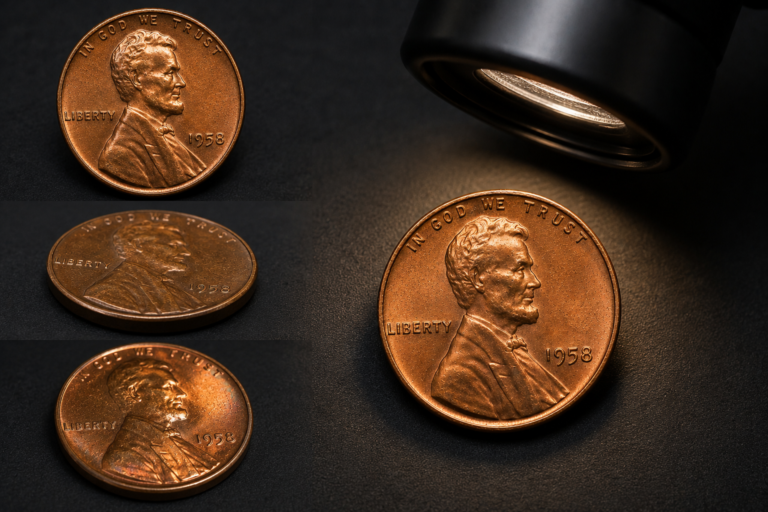
One of the most recognizable forms of mint luster is the cartwheel effect. When many Mint State coins are tilted beneath a directional light, bands of reflected light appear to rotate around the surface like the spokes of a wheel.
The effect is especially useful because it requires movement. A still photograph may show a bright coin, but rotation allows the collector to watch the reflection travel through different areas.
On a well-preserved coin, the movement can continue across the fields and around major design elements in a relatively coherent pattern. Where friction or wear has disturbed the surface, that pattern may weaken or break.
Not every coin displays identical cartwheel luster. Metal composition, strike characteristics, die state, surface finish, and preservation all affect appearance. Proof coins, for example, are evaluated differently from ordinary circulation strikes because their surfaces were intentionally produced with different visual characteristics.
The cartwheel effect is therefore a useful clue, not a universal test that every collectible coin must pass.
This is exactly why experts rotate coins under light. The information is contained not only in the reflection itself, but in how that reflection changes from one angle to another.
What Broken or Interrupted Luster Can Reveal
Imagine a band of light moving smoothly across a coin until it reaches Lincoln’s cheek and suddenly becomes weaker. That interruption deserves attention.
The highest points of a design are among the first areas exposed to friction. Even slight circulation can disturb the microscopic surface characteristics responsible for luster before dramatic design loss becomes obvious.
Interrupted luster can also result from rubbing, mishandling, or cleaning. This is why experts do not automatically interpret every luster break as circulation wear. They examine where the interruption occurs, what the surrounding texture looks like, and whether other evidence supports the same conclusion.
A break on a logical high point may suggest friction. Numerous unnatural interruptions across open fields may indicate surface disturbance. Fine lines flashing through the same area may strengthen suspicion of cleaning.
The method is similar to reading tiny surface changes to understand a coin’s history. One small clue rarely tells the entire story, but several consistent clues can reveal how the surface has changed.
Why Beautiful Color Can Be Misleading
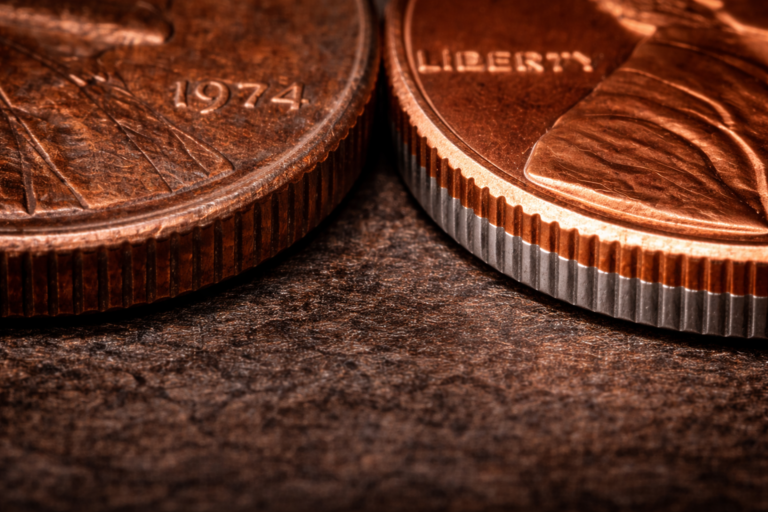
Toning is a natural part of the way many metals react with their environment, and naturally toned coins can be exceptionally attractive. Silver may develop shades ranging from pale gold to blue, violet, grey, or darker colors. Copper can progress from red toward red-brown and brown as its surface changes over time.
The mistake is assuming that attractive color automatically means an untouched surface.
Toning can develop after earlier surface disturbance. Color can also obscure subtle marks or make areas of weakened luster harder to notice in photographs. Artificially induced color exists as well, which means dramatic toning should never replace careful examination of the surface beneath it.
Experts therefore mentally separate the two characteristics. They ask whether luster remains convincing first. Then they decide whether the color appears natural, attractive, distracting, or suspicious.
This also explains why cleaned coins can appear more attractive than original coins. The strongest visual feature is not always the most informative one.
How to Compare Luster Correctly
You do not need complicated equipment to begin studying luster. A single directional light and two comparable coins are enough.
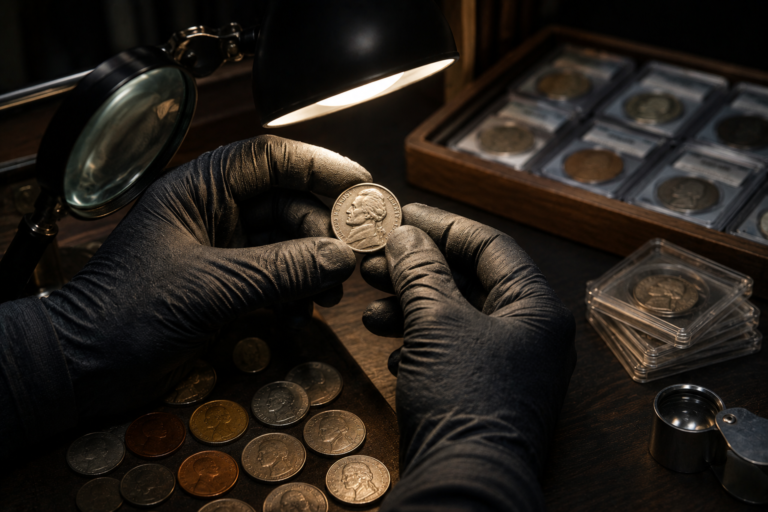
Hold the first coin at a slight angle beneath the light and rotate it slowly. Do not stare at one scratch or one letter. Watch the reflection across the entire surface. Notice where it begins, how it moves, and whether anything interrupts it.
Repeat the process with the second coin under exactly the same lighting conditions.
Using the same light is important because different lighting can completely change apparent brightness. Comparing one coin under a strong lamp with another under diffuse light teaches very little.
After studying movement, examine color. This order trains the eye to understand surface quality before responding to eye appeal.
Side-by-side examination accelerates the learning process, which is why experts compare coins side by side whenever possible. Differences that seem subtle in isolation often become obvious when two surfaces are viewed under identical conditions.
Two Similar Coins, Two Different Surfaces
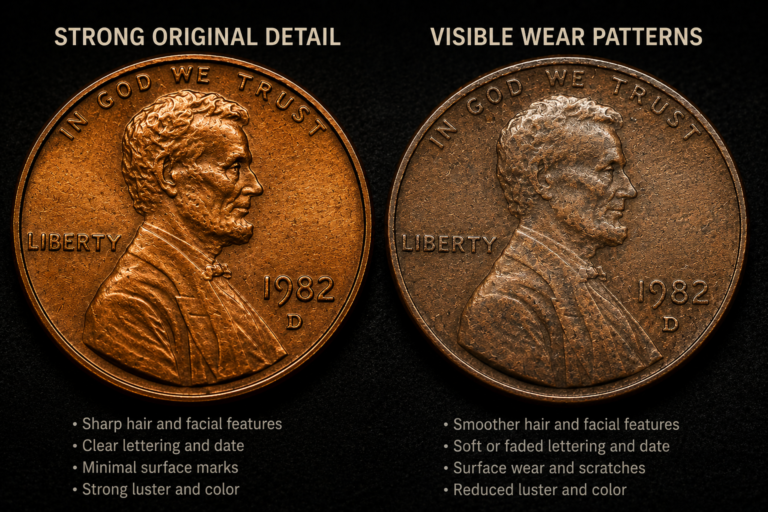
Consider two Lincoln cents with comparable design detail. The first has ordinary brown color but shows smooth, active reflections as it rotates. Luster remains visible around the lettering and through protected areas near Lincoln’s portrait.
The second cent has richer, more dramatic color. In a photograph, it is clearly the more attractive coin. Under movement, however, a broad area across the cheek and field appears dull compared with the surrounding surface.
A beginner may continue preferring the second coin because of its color. An expert pauses before making that decision. The luster interruption may indicate friction or another form of surface disturbance that deserves closer examination.
This does not automatically make the first coin more valuable. Date, mint mark, strike, grade, rarity, marks, and overall eye appeal still matter. The point is that color should not be allowed to hide information about preservation.
The same principle helps explain why coins with identical grades can look completely different. A numerical grade cannot fully describe every difference in luster, color, strike, and eye appeal.
| Feature | What It Can Show | What Experts Watch For |
|---|---|---|
| Luster | How the surface interacts with light | Flow, continuity, strength, and interruptions |
| Color | Toning and visual appearance | Consistency, natural appearance, and eye appeal |
| Brightness | Amount of reflected light | Whether brightness comes from natural surface character or alteration |
| Cartwheel Effect | Moving bands of reflected light | How smoothly the pattern travels during rotation |
| Broken Luster | Possible friction or surface disturbance | Location and relationship to other evidence |
Reality Check
Strong luster does not automatically make a coin high grade, and beautiful toning does not automatically make a coin original. Strike quality, marks, wear, surface preservation, eye appeal, and other factors still matter. Luster is powerful because it provides another way to read the surface, not because it replaces every other part of coin evaluation.
“Color catches the eye. Luster tells you what happened to the surface.”
Final Verdict
Experts compare luster before color because attractive color can influence judgment before the underlying surface has been understood. By rotating a coin beneath directional light, collectors can study how reflections move, where luster remains strong, and where friction or alteration may have interrupted it. Color still matters, especially for eye appeal, but it becomes far more useful after the surface has been evaluated. Train yourself to watch the light before admiring the color, and you will begin seeing coins less like photographs and more like experienced collectors see them in hand.
Frequently Asked Questions
Does a colorful coin always have original surfaces?
No. Attractive toning can exist on original surfaces, but color alone cannot prove originality. Luster, texture, wear, and other surface characteristics must also be examined.
Can a toned coin still have strong mint luster?
Yes. Natural toning can develop over surfaces that still retain significant mint luster. When the coin is rotated, the underlying reflection may remain visible beneath the color.
Does every uncirculated coin show strong cartwheel luster?
No. Luster varies with coin type, metal, strike, die state, surface finish, and preservation. The cartwheel effect is common on many Mint State circulation strikes, but it should not be treated as a universal requirement for every coin.